
[pagebreak:HAN1]
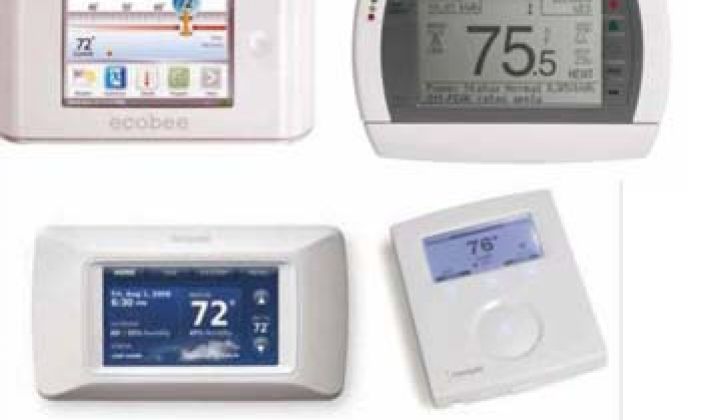
The notion of a home area network is vague indeed. As with the term 'smart grid,' ask two people what it means and you’ll get different answers. In the home space, it’s about a connected, energy-efficient home. Most people mention smart appliances and wireless thermostats. Others think of utility web portals and energy feedback data via snail mail.
The definition remained cloudy throughout 2011, but the industry saw advancements in fits and starts. Despite the exit of some major players, savvy startups saw deals on a much larger scale than in any previous years.
Although the market is still not clearly defined, home area networking in the energy space made enough noise in 2011 to let investors, utilities, and even some consumers know that it is here to stay. Here are the biggest trends in home energy management in 2011.
Convergence
There was a time in the distant past (that is, about three years ago) when home energy management startups had distinct offerings. Some were selling paper mailings with information about energy use, others had connected thermostats, while others still had powerful software platforms to drive efficiency and support demand response. Although analytics were the underlying foundation of all of these products, they were sold in very different casings.
Those days are waning. Now, utilities are thinking about scale and future-proofing their choices. No one knows what the iPhone of 2020 will be.
Opower, which has long been the champion of low-tech offerings via snail mail and web portals, partnered with Honeywell to marry the wireless thermostat with analytics.
On the other side, EnergyHub, which once called the dashboard central to its offerings, launched a platform that will be offered to television and cable providers, home security companies and utilities as a software-as-a-service that can ride on top of any wireless thermostat. The dashboard is still available, and EnergyHub sees the new service as complementary to, but not in competition with, its classic dashboard and software offerings.
Other companies, like Tendril, are offering up their products in any way clients want them. Tendril has already moved away from pilots that always include a hardware component to full deployments that might not put in a single thermostat for years.
Having the right solution for the market today, and tomorrow, isn’t just about having both hardware and software, but also about forging alliances. Trilliant established home energy device partners in the U.K. and in North America. Tendril is also partnering up with other vendors, such as ecobee. Integration is not just a trend in the home market, but also a larger trend in smart grid -- and one of Greentech Media’s top 5 smart grid trends of 2011.
[pagebreak:HAN2]
Open Data Access
Access to energy data is coming, even if it’s not as fast as some people would like. Even the White House weighed in during the past year, calling for all customers to have real or near-real-time access to energy use information.
But the question of who owns and distributes that data has been up for debate until recently. It’s still up for debate in most of the U.S., and most of the world for that matter, but some states are moving ahead.
California published smart grid data privacy rules, stating that consumers can share their information with third parties. For consumers who want to share their information with an outside company, a utility tariff will require that any home area network device that is “locked” to a certain third party, which will start transferring information from the smart meter, must be in compliance with the CPUC requirements. The utilities have six months to create those tariffs. They also must start a pilot study within six months to provide real-time or near-real-time pricing information to their customers.
Texas is arguably ahead of California. The Texas Public Utility Commission lead a committee that decided that Texans who are customers of the state’s four large energy delivery companies will be able to share their energy data with third parties as early as next year. The Lone Star state is already in the lead by requiring that every smart meter customer has access to their data through a website or other means.
Although Texas and California are only two of fifty states, they are big and they are further ahead on the smart grid curve than most other states. What Texas and California choose to do, others are likely to follow. And if the White House puts its money where its mouth (or policy paper) is, there will be easily accessible energy information for all. But don’t hold your breath.
Utilities large and small are also finding that a little bit of information goes a long way to win hearts and minds. Text alerts when bills cross certain thresholds and websites or emails to check the past week’s energy use are extremely popular with customers of both co-ops and big IOUs.
Now that some of the biggest kinks have been worked out in some of the biggest states, providing energy data -- and letting customers take it to other vendors -- will start to become a reality. Expect a trickle in 2012 and real movement in the market in 2013.
[pagebreak:HAN3]
HAN Proves Its Business Case
Many people, including this reporter, have questioned whether utilities want to shell out $400 per home to curb load. Pilots abound, but there are few examples of very large-scale projects to reduce residential load through HAN technologies.
That changed this year at Oklahoma Gas & Electric, which will install 150,000 smart thermostats for customers taking part in a critical peak pricing program to eventually shed 210 megawatts over the next three years.
In Oklahoma, the summers are hot, and delaying the build-out of new generation capacity is worth the $300 to $400 per home to install and operate the hardware. The utility also hopes to target some small commercial sites with the program.
Although reducing peak to delay generation is how OGE built its business case, Mike Farrell, director of customer programs at OGE, also told Greentech Media that this is about morphing into the utility of the future -- one that provides a suite of energy services instead of just holding the wires and sending monthly bills.
[pagebreak:HAN4]
Social Media Push
It seems as though the entire world is on Facebook. Utilities are, too -- well, some of them, anyway. Bounce Energy, an energy retailer in Texas, has more than 46,000 fans of its Facebook page. Reliant Energy, owned by NRG Energy, is just below 10,000, but it has a full-time social media team and even has a YouTube page filled with silly, fun, energy-related videos.
Although the two Texan examples show some of the more progressive efforts, others are catching on. Opower is launching a Facebook app early in 2012 that will be available to everyone, but is primarily tailored for customers of Opower’s utility clients. The app, developed in partnership with the Natural Resources Defense Council, will allow participating consumers to benchmark their energy use against similar homes, compare usage with friends, enter energy-savings competitions and share efficiency tips.
Constellation is also digging deeper into social media through a partnership. Constellation has formed an alliance with Lucid, an energy dashboard company that is best known for its work in institutions using competition and social media to drive energy efficiency and automated demand response participation. “It’s about making conservation a more viral offering,” Chris Cantone, senior vice president sales of load response at Constellation Energy, told Greentech Media when the partnership was announced.
Using partners to leverage social media will likely be a trend in coming years, but some homegrown social media expertise doesn’t hurt either. (Note to utilities: just have some interns get something started; they can probably do it in a day.)
Many utilities are successfully using Twitter, especially during outages. During the recent power outage at Candlestick Park during a Monday Night Football game, Pacific Gas & Electric actively tweeted the situation, even though they had no idea what was going on at the time. Other utilities have said that just jumping in head first (see intern note above) and having a presence -- any presence -- on social media has paid off.
Now that many utilities are getting comfortable with social media, they can start doing more with it. More promotions, more energy efficiency initiatives, more customer interaction. For those that do it right, they can get customers to trust them and even like them -- and not just on Facebook.
[pagebreak:HAN5]
Big Software Gets Out of Home Energy Management, Big Box Stores Get In
Goodbye, Google. Goodbye, Microsoft. Hello, Best Buy.
Both Google and Microsoft killed off their home energy management platforms in the middle of 2011. A lot of hubbub was made about it, and hence it makes this list, but it’s not actually as big a deal for the market as some media outlets would make it seem.
Google PowerMeter said at the time, "We first launched Google PowerMeter as a Google.org project to raise awareness about the importance of giving people access to data surrounding their energy usage. [...] We’re pleased that PowerMeter has helped demonstrate the importance of this access and created something of a model. However, our efforts have not scaled as quickly as we would like, so we are retiring the service.”
In fairness, Google did help raise the profile of the industry, but so did many other startups that are squarely focused in the market. However, Google didn’t put much muscle behind PowerMeter, and the offering was adequate but not anything spectacular. Ditto for Microsoft’s Hohm, which was essentially useless if you lived in a multi-family dwelling or had already made all of the basic energy efficiency upgrades (changing light bulbs, etc.).
In Microsoft’s case, it decided to concentrate more on commercial office space, where the payoffs for energy management are much higher than most homes. Google is down, but I wouldn’t count them out completely. They are interested in energy. Kansas City (both KS and MO) are going to be test beds for Google’s broadband service, and utilities in both cities are partners in the project. Home energy management tools will be delivered, at least in Kansas City, KS -- and it’s possible that Google will jump back into the HAN space in a much more significant way when the market has matured in a few years.
The bigger story in terms of heavy hitters coming and going from the HAN market is Best Buy making a push to own the space. Light bulbs and weather stripping are coming to Best Buy. They’ve already sold out of Nest thermostats for the year. Big city stores like Chicago are testing out home energy audits. Geek Squad for home networking? Yeah, they’ve got that.
When the big-box stores decide to make a real push into the space, that’s when the action will happen. That is where people shop. Best Buy is bringing these technologies to the masses where they already are. General Electric will be market-testing its home energy management platform in big-box stores in 2012. Home Depot already has $100 wireless thermostats from Radio Thermostat of America, which has partnerships with EnergyHub and Trilliant.
For Best Buy, it’s not just about energy, either -- after all, driving efficiency in the home is only so exciting. The store also sells electric vehicle chargers and refrigerators that can tell you if your milk has gone bad (and also happen to be extremely energy-efficient). Home area networking and the smart home aren’t just about energy.
Packaging the energy component with everything else home networking can offer makes for a more robust sales pitch to the average person. Getting a new GE washer and dryer? Maybe the GE Nucleus home energy manager could be packaged in with a rebate.
Energy management makes a whole lot more sense if it’s sold with the stuff that uses that energy. As people often note at smart grid conferences, we're not buying electrons from the utility; we’re buying warm showers and cold beer.
[pagebreak:HAN6]
British Home Invasion
If you think getting a monthly electric bill with no visibility into your daily usage is ridiculous, then the United Kingdom’s process is absurd.
The U.K. is an exceedingly appealing market for home energy management companies for many reasons, not least of all because consumers only have their meters read once a year and just pay estimated bills the rest of the time.
Lack of information, coupled with government action on smart grid projects -- including nationwide smart meters -- has made the U.K. one of the most interesting smart grid countries to watch in 2011.
In Smart Grid in Europe, 2012-2016, GTM Research reported that only around 110,000 smart meters have been installed to date in the U.K, but that the government has called for all households to have dual (electricity and gas) smart meters by 2020 -- a figure that will mean about 47 million devices will be put in place in the coming decade.
The uptake of consumer behavior programs is not surprising, as the U.K. government released a report earlier this year about how to empower people to save energy through rebates or other programs.
The government is currently undergoing trials for its Green Deal, which looks to help homeowners with energy efficiency improvements with no upfront cost starting in October 2012. The plan is that people can spend up to £10,000 ($16,500) for efficiency upgrades that can be paid back using savings from future utility bills. Like PACE programs in the U.S., the savings would be tied to the building.
The government support for reaching out to consumers for efficiency gains means that domestic and international companies are jockeying for position in the market. Homegrown companies AlertMe and Onzo are already working with some of the biggest utilities and telecoms, and 2011 saw Opower move across the Atlantic, as did demand response giant EnerNOC. Trilliant, which is working with British Gas on its smart meter rollout, announced a U.K. Interoperability Group for home energy management technologies. There is still a lot of work to be done, but the meters will go in quickly, and companies are poised and ready to take advantage of meter data as soon as its available.
[pagebreak:HAN7]
Nest Labs: The Thermostat Gets Cool
When covering smart grid, this reporter is often drawn to the word 'sexy' -- but it always has the prefix 'un' before it. There’s not a lot of sex appeal in the electrical utility world. Until now.
The Nest Labs thermostat is just one of what seems to be zillions of cutting-edge, wireless smart thermostats available. But it’s so much more. First of all, it’s so popular it is sold out until 2012. Unlike many thermostats from startups, it’s available in Best Buy. And it’s, well, sexy.
The Nest Labs thermostat was also the media darling of the home energy management space in 2011. We don’t just mean that Greentech Media covered it -- and unstealthed the company in the process. The New York Times had a review dedicated to it, which doesn't happen often with thermostats. Every popular science and tech blog seemed to mention it. I wouldn’t be surprised if my grandmother has heard of it.
Sure, it’s just one device. But bringing some sex appeal, and smarts, to a topic that is still off of the radar for the average American is no small deal. It brings a buzz to the market that is badly needed. If nothing else, it helps to show some less-than-progressive regulators that there are desirable products on the market that consumers are clamoring for -- and utilities need to have the systems in place to leverage the connected homes that are coming sooner than many people had anticipated.
[pagebreak:HAN8]
Small Commercial Comes of Age
Yes, this last one isn’t about homes at all. But small commercial energy management deserves a shout-out in 2011 because it is finally getting its due. In some cases, HAN companies such as Powerhouse Dynamics are tweaking their offerings to appeal to small businesses.
In other cases, startups like EnTouch Controls are shunning both homes and corporations and only working on small and medium commercial.
In some ways, there are similarities between the home and a small business. There is no facility manager, and whoever is paying the utility bill has little time to devote to such matters. The returns are also not necessarily as high as they are in the commercial and industrial space.
There are stark differences, as well. Although returns may not be as high for small commercial, in industries like restaurants and convenience stores, energy costs can still be quite high. In other markets, like retail, sensors are able not only to monitor energy use, but can also give visibility into shopping patterns to maximize the use of space and resources. In California, small commercial buildings make up nearly 25 percent of peak summer demand.
Large utilities are trying to find inroads to small commercial spaces and are just beginning to see results. Con Edison is finally seeing success with its Green Team, which hoofs it around New York City talking to small businesses about energy-efficiency upgrades, smart thermostats, and demand response programs.
Constellation Energy is also looking for a stronger presence with the little guys. One of the reasons for its recent partnership with Lucid was to have a product that could appeal to small and medium commercial customers.
It’s still early days, and the efforts will have to be huge. Con Edison has more than 100 people working in this sector alone. But there are some lessons from the home space that have allowed companies to adapt their offerings, or create new ones, to tackle a market that has bigger returns than the residential market.






 41
41
 15
15
 9
9