
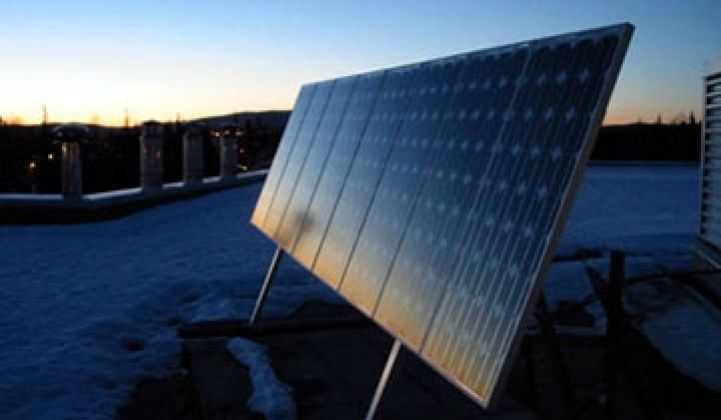
More than a year after German politicians fought over whether to dramatically slash the country's solar incentives, they are going at it again, this time ahead of a federal election next month.
In media interviews, political leaders from major parties have expressed concerns that the incentives, called feed-in tariffs, have largely benefited Chinese solar energy equipment makers instead of Germany's own, according to Alexander Karnick, an equity analyst at the Deutsche Bank, in a research note Monday.
The chatter has come about in advance of the parliamentary election on Sept. 27. A change in the political makeup of the ruling coalition could have a significant impact on solar energy policies over the several years if not sooner, Karnick wrote.
There isn't a strong indication at this point that Germany would lower its solar incentives soon, he added. "However if realized, it could mean a strong setback to 2010 demand, as well as margin expectations," Karnick said.
Until last year, Germany had been the world's largest solar market thanks to its feed-in tariffs, which require utilities to buy all the solar energy produced at premium, government-set prices. Spain took the lead last year, but the government has since reduced the subsidies and capped the amount of energy that could be sold under the subsidy program.
As a result, analysts now expect Germany, which doesn't have an annual cap like the one in Spain, to become the biggest market again in 2009 (see U.S. Solar Market: So Promising, Except for 2009).
Germany installed 1.35 gigawatts of solar energy systems in 2008, and it could add another 1.5 gigawatts in 2009, said Daniela Schreiber, head of research at EuPD research in Germany, at a solar conference in San Francisco in June.
After a contentious political debate last summer on the scale of the declines, the government agreed to lower them by about 10 percent for 2009 and 7 percent for 2010 (see Solar Prices Set in Germany). Some political leaders had called for cuts as high as 30 percent in 2009 and 9 percent in 2010.
The rates vary depending on the size and locations of the systems. The prices for small, 30-kilowatt rooftop installations are 43.01 euro cents per kilowatt hour; 40.92 euro cents for installations with the 30 to 100 kilowatt capacity; 39.58 euro cents for installations with 100 kilowatt to 1 megawatt capacity; and 33 euro cents for rooftop installations with more than 1 megawatt capacity. Ground installations will receive 31.94 euro cents per kilowatt hour.
Feed-in tariffs are supposed to decline over time because the cost of generating solar electricity is supposed to fall as the market grows.
But more cuts to the current feed-in tariff could prompt project developers and solar energy equipment makers worldwide to scramble and adjust their sales forecasts.
Solar companies have been battered by the credit crunch and the resulting slump in demand. While some companies have found ways to cushion the blow, many others have continued to see lower sales and profits (see Earnings: Is the Solar Slump Easing Up? and Q-Cells Cuts 500 Workers).
The concerns about Chinese companies' aggressive sales tactics aren't new. Karnick noted that proponents of greater cuts to the feed-in tariff last year also raised the issue.
Germany is the largest market for Tempe, Ariz.-based First Solar, which recently said it would launch a rebate program for its customers doing business in Germany.
First Solar makes cadmium-telluride solar panels, and it's facing stiff competition from makers of crystalline silicon solar panels (see First Solar Fears Competition From Silicon Panel Makers). Chinese companies are large producers of crystalline silicon solar panels.


 41
41
 15
15
 9
9