Wednesday, the Environmental Protection Agency finalized its revision to the Renewable Fuel Standard (RFS) program. Under the Energy Independence and Security Act of 2007 (EISA), Congress created requirements for how much renewable fuel (corn ethanol, biomass-based diesel, cellulosic ethanol, and other "advanced" fuels) must be blended in the nation's petroleum supply.
Although the revision does not change the fact that 36 billion gallons of biofuels are required to be consumed in 2022, it does make two significant changes.
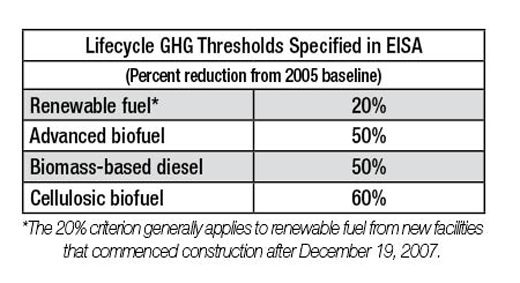
First, one of the unique aspects of the RFS is that lifecycle GHG emissions of qualifying renewable fuel must be less than lifecycle GHG emissions of the 2005 baseline average gasoline or diesel fuel that it replaces.
Several months ago, when the EPA released a draft version of the new fuel standards, they included "indirect land-use" calculations in the lifecycle greenhouse gas analysis. An example of indirect land use is when forests get cleared in developing nations to grow food crops that were grown in the West for biofuels. These forests contain sequestered carbon that gets released as these forests are chopped down and burnt. Any holistic lifecycle analysis must incorporate indirect land use into the equation.
Unfortunately, when the EPA originally calculated indirect land use, corn ethanol was found to have a higher carbon footprint than an equal gallon of gasoline – and thus would not qualify under the RFS. The corn ethanol lobby (i.e., Big Agriculture) cried foul and claimed that since there was no universally agreed-upon methodology for evaluating indirect-land use effects, the EPA should shelve it. The corn ethanol lobby also mobilized their Republican and Democratic friends in Congress, who subsequently threatened to pass laws taking away the EPA's power to regulate "indirect land-use" effects in life-cycle greenhouse gas analysis.
Under the final determinations established Wednesday, the EPA ruled that corn ethanol produced from a "new or expanded capacity from an existing natural gas-fired facility using advanced efficient technologies" complies with the 20% GHG emission threshold.
The EPA cites "significant new scientific data available to the agency," "rigorous independent peer review," and "extensive public comments" as the bases of their decision. Yet, one cannot help wonder if the congressional pressure vis-à-vis ethanol and agriculture lobbyists prevented the EPA from maintaining the independence necessary to maintain such a controversial finding as corn ethanol having a worse GHG footprint than petroleum? And while I have no evidence to suggest that politics played a role in the change in scientific conclusions that were published, I am not so naïve as to believe that lobbyists do not play a significant role –- probably larger than we are even aware of –- in the crafting of our laws. For better or worse, corn ethanol continues the roll it has been on (see A Comeback for Corn Ethanol?).
Which brings me to the other significant aspect of yesterday's ruling: advanced biofuels. While the EPA kept in place the target of 36 billion gallons of biofuel in 2022 (of which corn ethanol is not to exceed 15 billion gallons), it greatly reduced the amount of cellulosic ethanol required to be blended in 2010 (from 100 million gallons to 6.5 million gallons).
Cellulosic ethanol is a wonderful improvement over corn ethanol. There are a plethora of non-food based feedstocks that can be used (e.g., agricultural residues, woody biomass, municipal solid waste, etc.) and lifecycle greenhouse gases are lower due to the ability to burn the lignin and co-generate electricity. Yet, the costs of producing a gallon of cellulosic ethanol still remains higher than corn ethanol, due to the expensive enzymes required for breaking down complex polysaccharides into simple sugars for fermentation. Additionally, leading cellulosic producers like Bluefire Ethanol have been greatly affected by the credit crisis, and although they have shovel-ready projects, they lack the project finance to get their commercial facility up and running.
As such, the entire industry is coming to market much slower than anticipated. While we expect the first commercial facility to go online in 2010 (Range Fuel's 20 MGY facility in Colorado), 2012 should be the year where a massive ramp-up occurs (see GTM report Biofuels 2010: Spotting the Next Wave). Thus, the EPA had no choice but to downwardly revise the quota for 2010. Don't be surprised if next year the same thing occurs for 2011's quotas (which call for 250 million gallons to be produced).
It remains to be seen what the consequences of the EPA reducing the cellulosic ethanol requirement will be. Regardless, it is a sobering reminder that despite the hope/hype of advanced biofuels (i.e., cellulosic ethanol, biobutanol, algae, etc.), 1st generation biofuels, like ethanol and biodiesel, remain the only current commercial options.






 41
41
 15
15
 9
9