Do-It-Yourself Solar at Lowe’s

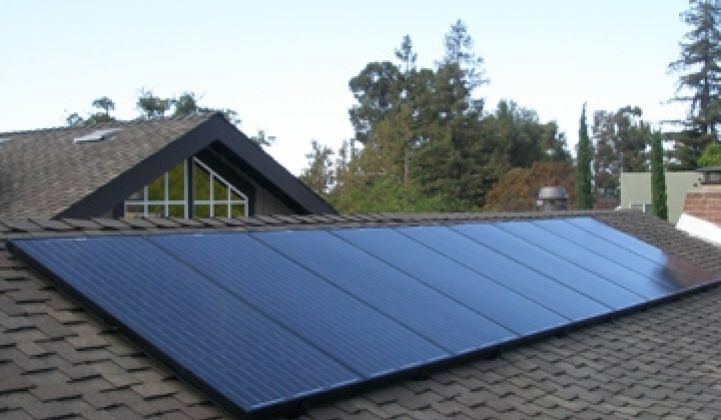
Akeena Solar’s Andalay systems are designed to make it possible for handy homeowners to do their own installations.

It's inevitable: More do-it-yourself solar panels will be available, this time in your nearest Lowe's.

Lowe's is now carrying solar panels from Los Gatos, Calif.-based Akeena Solar that feature built-in writing and racks and an installation technique that aims to simplify the steps and shorten the time it takes to put solar panels on a rooftop (see video from Akeena).

Lowe's is selling the Andalay at $893 per panel, available at 25 stores in California. Akeena said handy homeowners could install the panels themselves if they don't want to hire people to do it, but they might still need an electrician to connect the rooftop system to the home's circuit.

The announcement brings home what Akeena and some other solar companies see as the future of residential solar market. Instead of hiring contractors or roofers, homeowners could install solar panels themselves and save on labor costs (see An Ikea for Solar? and Getting Solar Energy Cheap and Easy).

A number of startups are developing this kind of do-it-yourself solar energy systems, including Armageddon Energy (see video). Meanwhile, companies such as Dow Chemical are working on solar cell-embedded roofing materials, which will require strong insulation to protect the cells from moisture and other weather elements (see Dow to Roofers: Our Solar Shingles Are Coming).

Other big-box retailers such as Home Depot already sell solar panels and related parts, though they sell them along with installation services and even financing.

Whether homeowners would embrace the do-it-yourself idea is uncertain. A solar energy system remains a bulky appliance, and erecting them on a roof isn't as easy as plugging in your big-screen TV. 

Akeena announced an impending launch of Andalay in late 2007, and followed up with another press release in early 2008 to say it would buy microinverters from Enphase. Akeena began selling Andalay systems in May this year. 

Petaluma, Calif.-based Enphase formally launched its first microinverter product in mid-2008 (see Enphase Energy Seeks New Converts). The startup says its microinverters could better monitor the power output of each panel, and they could harvest more energy from the panels as well.

The use of microinverters allows Akeena to design a simpler solar energy system. Each Andalay panel has a microinverter attached at the back for converting the direct current from the solar panels to alternating current for on-site use or for feeding the grid. Most of the solar energy systems installed today use centralized inverters.

Using microinverters allows Akeena to eliminate some of the high-voltage DC wiring that would otherwise be necessary to bring the electricity from solar panels to a central inverter, which typically sits in a box next to the house.

Akeena has designed panels with electrical connectors on the side of each panel, so that plugging them together should be even simpler than the version available on the market now. The new design is undergoing testing at Underwriters Laboratories.

Photo of an Andalay solar panel installation via Akeena Solar.

21 Comments

  • rooferguy 12/10/09 7:18 PM

    Great for California, but when is Lowe’s going to be selling in New Jersey?

    Reply
  • sn8k 12/10/09 8:02 PM

    Who writes this stuff?  You’re got it backwards in paragraph 9.  “Each Andalay panel has a microinverter attached at the back for converting the alternative current from the solar panels to direct current for on-site use or for feeding the grid.”  It’s the opposite.  The micro-inverter converts DC into AC for feeding power to the grid.

    Reply
  • rooferguy 12/10/09 8:58 PM

    Heck, it’s all Alternative Energy!

    The challenge for us in the industry is to make things so simple that it doesn’t matter if it’s AC or DC, silicon or silicone.

    Like computers—people don’t care any more about their processor model or type of RAM—just that they work.

    Buy a solar panel, connect it safely, make electricity, save money.  That’s the point.

    Reply
  • JoeJoe 12/11/09 1:31 AM

    Rooferguy… I love hearing an installer say he likes a technology that competes against his skillset. No sarcasm intended with that statement. The guys I work with constantly bitch about technology doing their jobs. Back in the day we used slide rulers and walked uphill fighting off bigfoot to get the job done… yadda yadda yadda… Seriously, I hear Player Piano complaints every single day. One day you’ll be the old timer telling the kids about the DC days… Back in the oughts we did real work, sniff, huff, none of these plug and play doohickies… 

    These daydreams are comforting…

    Reply
  • KK 12/11/09 1:04 PM

    $893 per panel?  If this is a 200W panel that is ~$4.50/W.  Isn’t that a little much for DIY installation?

    Reply
  • J 12/11/09 2:00 PM

    I believe they are 72 cell 175w modules to match the enphase units

    Reply
  • Sara 12/11/09 5:07 PM

    Its a 175W panel….$5.1/W….i don’t see any advantage in paying $5.1/watt and install it by your self (which most probably you can’t do unless you are good in working on the roof). Eventually end up calling someone and pay for installing.

    Reply
      • Karyn 12/12/09 11:38 AM

        The problem in Arizona is you won’t get any utility incentives if you install it yourself.

  • Flash 12/11/09 8:14 PM

    What is the size of the market for homeowners who:

    1. Are comfortable safely hefting 45 lb solar panels onto their roof?

    2. Are willing and able to poke holes in their roof and find rafters?

    3. Are comfortable taking responsibility for sealing all the holes?

    4. Want to install a circuit breaker and run AC wiring and a ground wire from their roof to their load center?
    5. Want to go pull any required building permits (don’t worry about the utility rebates - the homeowner cannot get those without an electrician’s license, building permit, etc.)?

    While much more simple than a DC system, installing AC solar systems is much like installing a garage door or switching out an HVAC system.  You need to do some structural and some electrical work.  How many homeowners do those things themselves vs. just hiring a contractor to install? 

    They won’t be selling a lot of these systems.  If they do, they will be taking a lot of returns or… sending Akeena out to do the installation.  This won’t save the homeowner money over the “old fashioned” way.  But, hey, great publicity and momentarily good for the stock price!

    Reply
  • FA 12/11/09 8:41 PM

    Many contractors buy their supplies from Home depot, Lowes, Orchard, etc. What Akeena did enables small bussiness contractors to get in the Solar installation bussiness. I take it that the utilities are OK with the quality of AC delievered by the Enphase inverters. I know they worry about harmonics and noise in the AC waveform.

    Reply
  • BigVolt 12/12/09 12:10 PM

    If a contractor is serious about getting into the solar PV installation business they will be sourcing the panels and inverters directly from the manufacturer. With the glut of panels this is now possible at prices below $3 per watt and self installs can be done at under $5 per watt - less than what it costs to buy an Andalay AC panel.

    Home Depot already went through this exercise with a pilot program in some of their Southern California stores.  They now only sell the panels on their website.

    Granted it’s great publicity for Akeena but this announcement is really about raising the price of Akeena’s stock, nothing more, nothing less.

    Reply
      • ADUP 12/14/09 5:02 PM

        A contractor that is serious about getting into the PV installation buisiness will be sourcing direct from the manufactorer. With the glut of panels, it is now possible at prices below what it costs to buy Akeena’s product. (thanks BV)  As a talented home owner, home owner with freinds, freind with talents, small contractor, large contractor, Anyone and Everyone can use their individual and collective common sense to invest in; [ their own house hold system, the close community grid, and the larger grid ]. or in some way incorporate solar devices into daily use. Unless you own or plan to own stock in a big box, don’t worry about their profits Just use the BB’s as the hardware store they are and utilize direct marketing wherever you can and don’t be afraid to call around to the new and local contractors who will all tell you something new when you request a bid. If enough people network around the products they are interested in using, prices will fall as the tech. improves. Don’t wait for comcast to tell you its cool.

  • Freedomrenewable 12/12/09 1:01 PM

    Enphase inverters are great for ground and pole mount systems. But can you imagine 10 years down the road when inverters will begin to fail? Let the never ending service call begin!

    Reply
  • Cathy 12/15/09 12:04 AM

    If you study this panel more, you’ll see that the price of $5.10 per watt includes all the racking, roof-mounts, flashing, grounding, and micro-inverters. So comparing it to panels at $3.00/watt is not a fair comparison because you still have all the racking and inverters to add to that. Oh and enphase micro-inverters have a mean time between failure of 331 years. So get used to it. All these panels need is a dedicated circuit. I am so tired of the “old solar guard” berate AC Solar, just like when Tom Watson of IBM predicted in the early 1970’s that probably only about 2 people would buy a personal computer if there ever was one.
    Next year, there are about five other micro-inverters ready to hit the market, most of which will come prepackaged with panels for AC solar right out of the box. And, enphase and others are building AC panels that will convert to AC right in the junction box on the back of the panel.
    The world of solar is changing, get used to it! Just like the iphone is to cellphones and the macbook is to pcs, AC solar is here to stay and it is going to be a great boost to the industry taking solar right into the faces of mainstream America. They are planning to have a kiosk that tells customers “why solar?”, “How it works” and other great information to take the fear out of solar and blow this market wide open.
    Oh and for you old-time installers, don’t worry, everyone knows that you can buy a gallon of paint at Lowes for $30.00 and yet people still pay about $800-$1,000 just to get their living room painted. That is a pretty good premium for hiring someone to do the job right. There will still be room for trained installers, only the job just got a lot easier! smile It’s Bill Brooks and John Wiles and the whole NEC code stuff that may have to change. Before you know it, the only license you’ll need is an appliance license. Say good-bye to temperature coefficients, combiner boxes, and giant mamouth centralized inverters. Hooray for Akeena! Hooray for enphase, and all the others that are going to help this country adopt solar in a major way and finally move us toward energy independence!

    Reply
      • Flash 12/16/09 2:51 PM

        Go to Lowe’s and you will see that for a 1 kW installation the price is $6.30/Watt (this includes roof mounts and all the other components you need), $6.80/Watt if you want monitoring to know that it is working.  Price goes up for a smaller system and down for a larger system, but in many places you can pay for a complete installed system the “old way” for less than this.  And you don’t usually get a utility rebate if you self install.

  • Commander 12/15/09 8:41 PM

    The last paragrah reads:

    Akeena has designed panels with electrical connectors on the side of each panel, so that plugging them together should be even simpler than the version available on the market now. The new design is undergoing testing at Underwriters Laboratories.

    Does this mean that the pannels that are being sold are not UL listed?  Or is an older UL listed design being sold?  Wierd

    Reply
  • VTXrider 12/27/09 6:42 PM

    You don’t need to go with Akeena to use the Enphase system, just shop around for your best deal on 60 or 72 cell panels that are on Enphase’s comparability list and install with your choice of racking systems. What Enphase AC microinverter’s give you is flexibility. You are not restricted to 4 panel sets or a fixed number of sets to get the 600 VDC needed for most centralized inverters. You are not working with high voltage DC, combiners, and all the rest, plus you get to monitor your system’s performance panel by panel instead of one unit. And if an inverter goes out your entire system does not go down, just the one panel, unlike centralized systems. Can be installed by an AC certified electrician, of which there are many to choose from, lowering cost. All in all a much more elegant and simple system that like it or not is the wave of the future for solar.

    Reply
  • Mr Cockram 12/31/09 9:49 AM

    Lots of information out there to help you with Solar Panel, Solar Energy ideals and technical inormation.
    I have tried this site http://solarhow.org which has lots of information about how to build your own Solar Panels, Windmill etc.
    I hope all this helps

    Reply
  • Rob 02/3/10 8:33 PM

    DIY mountings to the roof…  this should help Roofing Contractors builtd more business correcting the installation and leaks.  I would think.

    Reply
  • prontopower.com 02/25/10 8:08 AM

    I love the idea that they are finally encouraging the DYI folks to install solar. But I’m bummed that rebates and possibly credit from the power they make might not be available for the DYI installation.
    Bout a year ago I wen into home depot and tried to buy solar panels. “Nope can’t get em’” was the reeply
    then I said… isn’t home depot the DYI store? anyhow glad to see lows beat HD.. I like lows better!

    Reply
Need an avatar? Get one here: Gravatar
.