• Tuesday, May 12, 2009 Latest Update: 12:25PM

Greentech Solar

California Sees Jump in Solar Rebates, Gov’t Customers Lead the Way

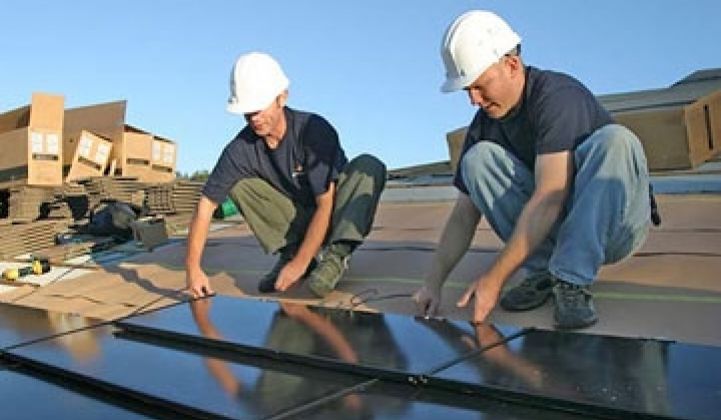
The number of solar energy installations has nearly tripled so far this year, but new applications filed during the same period show that residential business is sluggish while the government sector is booming.

The number of solar energy installations in California shot up nearly three-fold during the first four months of this year, state data shows. Government agencies, in particular, are leading the way on installations.

Solar service companies installed nearly 90 megawatts of solar power systems for from January through April this year, compared with 33.4 megawatts for the same period in 2008, according to the California Solar Initiative (CSI). The CSI is a rebate program that is available to customers of the three largest investor-owned utilities: Pacific Gas and Electric, Southern California Edison and San Diego Electric & Gas.

Residential installation grew 58 percent for the first four months to reach 19.3 megawatts for the first four months of this year from 12.2 megawatts a year ago, while installations on commercial, government and nonprofit properties tripled to 70.6 megawatts from 21.2 megawatts.

A change in federal law that went into effect in January and allows homeowners to claim a 30 percent investment tax credit has made a difference, said Daniel Englander, a senior energy analyst at GTM Research.

Englander noted that the big boost in the amount installed most likely came from applications filed in late 2008, however. The new residential applications filed in the first four months of this year in fact declined 14.1 megawatts from 20.5 megawatts in the last four months of 2008. The fact that rebates for PG&E customers were set to become lower in December also contributed to the spike in applications.

The non-residential applications have shot up from 31.4 megawatts in the last fourth months of 2008 to 52.6 megawatts in the first four months of 2009, the CSI data showed. During the first four months of 2008, the CSI received 29.3 megawatts worth of applications.

The non-residential sector has historically been larger than the residential one because the sizes of solar energy systems that go on top of warehouses, schools and others tend to be larger. Anticipating that rebates for non-residential customers would become lower in February, applications for that month reached 22.8 megawatts, the most of any month since the CSI's launch in 2007.

Mark Bachman, a senior equity analyst at the Pacific Crest Securities sees more value in examining the data for new applications rather than the amount installed. He said application data provide a better indication of current and future market trends.

A recent analysis of the non-residential applications showed that government customers are driving the growth, Bachman said. He culled information from the raw data in the CSI database but used the power generation capacities listed by the solar panel manufacturers (expressed in direct current).

The CSI uses a different metrics that looks at the power output of a solar energy system in alternating current (AC) and takes into account real-world conditions such as shading. As a result, the generation capacities presented by the CSI are typically lower than what the manufacturers claim.

Government applications for the first four months of this year jumped to 33.1 megawatts, or 153 percent, from the same period a year ago, Bachman said. Commercial applications rose 22 percent to 21.9 megawatts while residential applications increased 8 percent to 16.4 megawatts.  The nonprofit sector jumped 242 percent; but at 6.8 megawatts, it's the smallest slice of the pie.

Overall, the applications for all the market segments grew 59 percent, Bachman said.

"It's easier for the government to finance a project than for a residential or commercial customer," Bachman said. "With governments, they are going to pay the bills. There is a lot more certainty."

The federal stimulus plan has set aside $5.5 billion to make federal buildings more energy efficient, and that could include installing solar energy systems. The plan also is creating a grant program to boost other types of solar installations. But the government is still drafting rules for how to dole out these funds, which are expected to become available until the second half of this year.

The applications also showed that solar panel makers Sharp and SolarWorld are gaining new converts fast. Sharp occupied 16.9 megawatts worth of applications for both residential and non-residential types from January through April this year, a 176 percent jump from the same period a year ago, Bachman said. SolarWorld followed with 15.6 megawatts, or a 235 percent hike, and SunPower with 13.9 megawatts, or a 14 percent gain.

Suntech Power's name might appear only on 9.1 megawatts worth of applications for the first four months of 2009, but that quadrupled what the company had a year ago, Bachman noted. 


Join industry leaders and influencers at Greentech Media's Concentrating Solar Technologies & Markets at Intersolar in Munich, Germany on May 29.

Comments [11]

  • Joe Real 05/12/09 12:51 PM

    The main reason why the residential sector is sluggish is because of the price. We have heard of many news about cost of production around $1/watt to sub $1/watt but it hasn’t trickled down to the retail residential. This only means that the installation costs are unrealistically too high.

    Another reason is that many companies, especially those in the solar industry, have outsourced their jobs, and the manufacturing jobs to overseas.  With most of the jobs gone to overseas, the potential residential buyer base has been eroded, and there’s not enough people with jobs who will afford to buy solar panels even with hefty tax credits.  They don’t have tax credits to take advantage of anyway, because many have lost their jobs or have taken a much lower paying jobs. Thanks to all of our executives who rake in the money for themselves by outsourcing the US jobs and the manufacturing plants.  So it is really no wonder why there are very few customers in the US with good jobs who will be able to afford higher priced items such as Solar Panels.

    Reply
      • Peter A 05/12/09 1:59 PM

        I’m going to make the argument that it’s exactly because of outsourcing that we’ll be able to afford solar panels. Why do you think you can afford the computer you used to type your post?

      • Joe Real 05/12/09 2:15 PM

        @Peter A, you admit that you are using non-US made computer? Do you work for the Chinese?
        It is not only the solar industry that are outsourcing many jobs. So, your argument is short-lived when it comes full circle, when the temporary buffer has been consumed, and most of us are out of jobs, even the supposedly cheaper solar panels, most people won’t be able to afford them.

        Solyndra are building their solar panels here in the US. Aptera motors are building the next generation EV here in the US with US made parts, and GE has started building their manufacturing plant for heavy duty batteries in New York.  These are a few of the companies that will help rebuild the US economy to recovery by creating jobs here. We need good jobs here to buy big ticket items sold here.

  • John Barnes 05/12/09 2:00 PM

    In 2007-2008 it was most financialy responsible for companies, based in the US, to build plants in Germany where the demand was much higher and all capacity could be consumed.

    Now in 2009-2010 with the colapse of the Spanish market and new incentives coming into the US market, new announcements of US plants from Schott, First Solar, SolarWorld and possibly even SunTech will create some manufacturing jobs in the US.

    The residential sector is not the sector for massive solar deployment anyway.  That is with MW solar PV farms and 100 +MW CST farms in the SW.  Recent help by Salazar and BLM to free up the 200 or so site approvals will make a major change in solar deployment in the SW.

    Reply
      • Joe Real 05/12/09 2:22 PM

        What is the reason why the reported lowering of solar PV prices everywhere hasn’t trickled down to the residential retail?  I checked for solar PV prices available for residential retail and they haven’t budged much. The price quotes of installations before the rebates are still around $8-$13/watt. it should have been $5 to $8/watt if prices have trickled down.

  • John Barnes 05/12/09 2:20 PM

    With regard to the nice article by Ucilia above, it should also be noted that the CSI report stated that so far 41% of the solar installations, by size, were performed with a different host and owner of the installations.  That is the big solar power providers (SunEdison, MMA(Fortowatio),Recurrent Energy, Solar Power Partners) by financing, owning, and selling energy thru a PPA to the host are providing a major share of the solar now in use by the California CSI.

    Reply
  • Solvida 05/12/09 6:55 PM

    One reason may be inefficiency in the installer/integrator realm for which the high cost of PV panels and full systems has provided a “smoke and mirrors” effect.  Freefalling module prices puts tremendous pressure on integrators to pass on savings to end use clients. An intelligent observer, or even a mild observer, of PV industry since 1995 would know 1) PV systems are very expensive 2) PV panels are the most expensive component of a PV system. Knowing now that prices for modules are halved since 2007, why wouldn’t the observer call his local integrator and ask for a 50% reduced system quote?  Very transformational time where downward price pressure will force inefficient integrators out of business, into consolidation or (hopefully) down a path towards more cost effective installation methods and practices, more transparency and long term sustainable growth for the CA PV industry. this is how solar can go mainstream, not with smoke and mirrors.

    Reply
  • Peter A 05/14/09 6:11 PM

    @Joe Real: There is no such thing as a “US made computer”. There is, however, such a thing as a “US designed” computer. And here lies the difference: In the post-industrial age, we have discovered that there is higher value (and profit margin) in DESIGNING things as opposed to MANUFACTURING them.

    Reply
  • rooferguy 05/15/09 6:23 PM

    Good article, Ucilia.  In my experience the installation costs haven’t fallen dramatically because installers are still taking the same time to mount and wire up rooftop panels, and the incentive paperwork has gotten more complicated — not less.  There have been some installation efficiencies among bigger installers, but the stuff we install (DC panels, racks, lots of wiring, inverters) hasn’t really changed a bit.  When there’s literally less STUFF to install, then you’ll see the installation costs drop significantly and solar systems get a heck of a lot cheaper.

    Reply
  • jak 05/16/09 10:58 PM

    The reason that homeowners aren’t installing solar is simply because they don’t have any money. In case you haven’t noticed,  many homeowners are underwater on their mortgages, others are already in default. Those that aren’t are maxed out on HELOCs and second mortgages. I was just taking with a guy this week on the light rail who would like to get solar but he bought in 2006 and can’t refinance because the bank claims he’s under water on his mortgage. On top of that, many of the deals where the solar installer essentially owns the hardware and the homeowner pays for the power were financed by Lehman Bros., now bankrupt. So those deals, which even homeowners who were under water could afford, are not as easy to finance.

    I think you can probably write off the residential solar market for the next 3-5 years.

    Reply
.