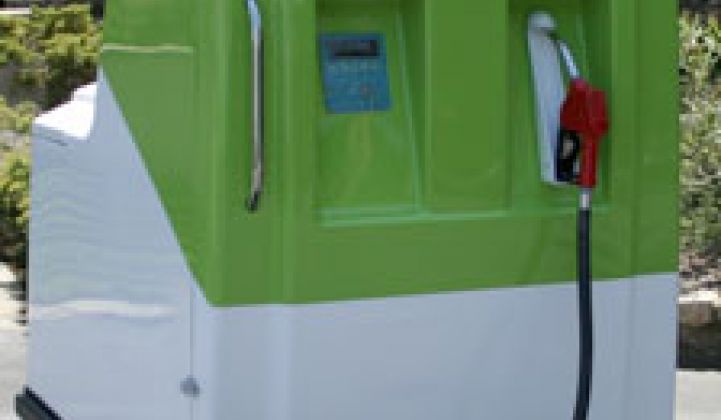
Don't live in the Midwest? Then chances are you'll be hard pressed to find a fueling station that dispenses E85, a mix of 85 percent ethanol and 15 percent gasoline.
California only has two public locations where drivers can opt for the high-ethanol blend, according to the U.S. Department of Energy. And some drivers can cross whole states without finding a single station.
This means it takes a high level of devotion to drive solely on the fuel, like these guys from KicktheOilHabit.org who resorted to storing canisters of E85 in their car's trunk as they went through Wyoming.
A small startup in Los Gatos, Calif., says it has a solution – making ethanol at home. Well, actually in the yard, considering federal law prohibits making ethanol inside the house.
Founded last year, E-Fuel has developed what it claims is the first home ethanol system for the masses. Simply add sugar, yeast, water and a standard household 110 or 220 AC power supply, the company claims.
Last week, the company announced it was taking orders for its appliance-sized ethanol maker called the EFuel100 MicroFueler (click here for a demo on how it works), with deliveries expected to start in the fourth quarter of 2008.
But the ability to fill up on 100 percent ethanol from home won’t come cheap. E-Fuel plans to sell its MicroFueler for $9,995.
U.S. customers may be eligible for federal tax rebates that would drop the cost to $6,998, according to the company.
Despite the high up-front price, the company claims consumers can expect to see a return on their investment in about one and a half years. That’s because the operational cost of making ethanol will average about $1.25 per gallon, compared with gasoline at $3.50 per gallon, E-Fuel says.
The company calculated the payback period based on a two-car household with each car driving 12,500 miles annually for a total of 25,000 miles and using 1,922 gallons per year, according to its Web site.
But the math doesn’t pan out in reality. First of all, ethanol delivers about a third fewer miles per gallon than gasoline, bringing the equivalent cost to about $1.67 per gallon.
Second, most cars in the United States aren’t equipped to run on E100 (although companies such as Honda and Toyota have introduced E100 vehicles in Brazil). That means most drivers would need to buy a conversion kit to enable their vehicles to use the fuel, further adding to the cost and extending the payback period.
E-Fuel’s calculation also accounted for the subsidized price, according to its Web site, meaning that if customers turn out not to be eligible for the $3,000 federal subsidy – even assuming they have E100 vehicles -- the payback period would extend to about three years.
The calculations also assume that drivers stay close to home, using only E100 all year.
Of course, if the price of gasoline goes up, the payback period will decrease, and if the price of sugar increases more than the price of gasoline, the period also will increase.
E-Fuel also is trying to build partnerships with sugar distributors in which E-Fuel customers could exchange carbon credits for a price reduction on sugar, bringing the cost of producing ethanol down to less than $1 per gallon, the company said.
But there are additional issues that might limit the MicroFueler’s market.
Not all potential customers have yards or other outside property where they could make the ethanol, for one thing.
It’s unclear how many E100-capable owners are devoted enough to want to take the time and effort to make their own ethanol moonshine (and convert their cars). It takes five to seven days to make a batch of up to 35 gallons, the Microfueler’s maximum capacity, enough to fill an average fuel tank twice, or two average fuel tanks once.
And they’d also better have good backs because it takes about 13 pounds of sugar to create one gallon of ethanol – meaning a 35-gallon batch would require 470 pounds of sugar.
But revolutions usually don't come about without some backbreaking labor.
Tom Quinn, E-Fuel's founder and CEO, is betting that E-Fuel's technology will help drive public ethanol interest and tap into what he sees as a growing desire by consumers to curb their individual reliance on fossil fuels.
Quinn, who also is E-Fuel's sole backer, previously founded memory-storage company Samsung Information Systems America, which he grew to $200 million in revenues, and built Gyration, the holder of the patent on which the Nintendo Wii controller is based.
While serving as Gyration's CEO, he raised $40 million in funding and sold the company to Thomson in 2004.
In essence, Quinn's latest company is attempting to solve one of ethanol's biggest challenges -- distribution. The inability to send ethanol through existing oil pipelines is among the major hurdles to getting the biofuel to more fueling stations.
But Rick Kment, a biofuels analyst with research firm DTN, said the product is too expensive to revolutionize the way the masses get their fuel.
"It will be hard to get people to pony up $10,000" or even $7,000, he said.
Kment also said the MicroFueler may be too labor intensive to take hold in the mainstream, especially when compared to the ease of pulling up to a gas-station pump.
"I think there is a niche market for some of the do-it-your-selfers," he said. "It's going to be more of a novelty."




 41
41
 15
15
 9
9