[pagebreak:BlueFire to Break Ground]
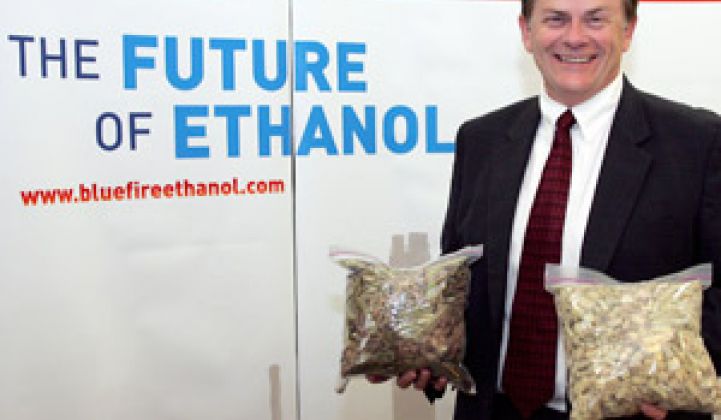
BlueFire Ethanol plans to break ground on its first commercial cellulosic-ethanol plant in the next few months.
The Irvine, Calif.-based company is in the final stages of obtaining building permits and expects to begin construction this quarter or the beginning of the third quarter, CEO Arnie Klann told Greentech Media. In April, the company announced it had selected Brinderson as its contractor for the project.
The facility, which will be adjacent to a county landfill in Lancaster, Calif., will have the capacity to produce 3.1 million gallons of ethanol from garden and wood waste and nonrecyclable paper, he said.
BlueFire expects to begin operations at the plant next year and to sell ethanol from the facility starting around June, he said. It also hopes to double the plant’s capacity in a few years as the amount of biomass coming to the new landfill grows, he said.
“We’re excited about the ability to take the materials that we as a society value the least and convert them into a value-added product,” Klann said. “It helps us as a country reduce our imports from foreign oil and become more self-sufficient, and it benefits the communities that we’re in, not only in terms of job creation, but because we’re creating a cleaner-burning fuel that lowers the greenhouse gases.”
Last year, BlueFire, which is traded over the counter under the ticker “BFRE,” won a $40 million grant from the U.S. Department of Energy to develop a 19-million-gallon-per-year plant at another landfill in Corona, Calif. The company expects that second commercial facility to be up and running by 2010 (it previously had announced an expected start-up date of 2009).
The company expects that facility to convert about 700 tons of biomass into ethanol each day, while the Lancaster plant will consume about 175 tons per day.
Ethanol companies have faced some financial difficulty, as prices for corn has increased, and controversy as scientists have questioned biofuels’ environmental impact, energy use and effect on land use and food.
Advocates hope that cellulosic ethanol -- which is made out of nonfood materials such as switchgrass, wood chips and corn cobs -- could help temper those concerns, reduce costs and make ethanol mainstream.
But the technologies haven’t yet lived up to their promise.
So far, cellulosic ethanol remains more costly to produce and manufacturing plants haven’t reached mass production. The difficulty of economically harvesting and collecting enough cellulosic material to continuously run a large plant is another challenge, as most of the material is spread around instead of gathered into one place (see Q&A: Harvesting Cellulosic Ethanol).
BlueFire plans to circumvent that difficulty by locating its plants at landfills that already separate out green waste such as tree and bush trimmings.
The company uses a “concentrated acid hydrolysis” process based on technology licensed from Arkenol, and says it has developed a number of its own improvements.
The technology has been tested in three pilot plants: one in Orange County that BlueFire operated for five years to develop its intellectual property, and two that the Japan Gas Co. built in Japan four years ago as part of a licensing agreement.
According to Klann, the company begins by grinding the waste down to a certain particle size.
BlueFire then combines the particles with sulfuric acid, which breaks down the biomass and releases the lignin structures, he said. The lignin is screened out, using a sugar press, and burned to provide electricity back to the facility. The acid is separated from the sugar (and reused), and the sugar is converted into ethanol using a standard yeast-fermentation process.
The process delivers about 70 gallons of ethanol per ton of green waste, Klann said.
The company has designed modular plants so they can be produced in a factory and put together “like an erector set,” he said. “It’s like doing a pre-fab home, only for a process plant.”
The Lancaster design represents the smallest module that BlueFire expects to sell.
“It’s the smallest [BlueFire] plant you can build that’s actually economically viable,” Klann said. “We designed it that size because that’s the amount of feedstock that’s available, and we see it as a standard design that we’re going to deploy around the world in areas that are limited in terms of how much [feedstock they can collect].”
The company also plans to sell a 19-million-gallon-per-year module, such as the one it is building in Corona, and has designed a 55-million-gallon-per-year plant, he said. And BlueFire expects even its smaller first plant to make money, he said.
[pagebreak:BlueFire: Continued]
Aside from selling ethanol, BlueFire plans to bring it revenue by selling carbon credits. It expects even its smaller project to make money, Klann said.
The company plans to develop, own and operate its facilities – not a small goal in a market where financing can be hard to get – and plans to build about 50 plants in the next 10 years, he said. It also aims to grow its revenue to between $4 billion and $5 billion by then, he said.
And BlueFire later hopes to expand into other feedstocks, including forest thinnings and crop residues, such as rice straw, corn stover and sugarcane bagasse, he said.
Nobody can accuse the company of aiming low.
But James McMillan, a manager at the National Renewable Energy Laboratory’s National Bioenergy Center, said it does face some risks and potential challenges in reaching its lofty goals.
Because green waste is so diverse, BlueFire could find itself dealing with many different types of sugars, some of which might not get broken down as part of standard fermentation, he said. The risk is that other organisms that eat those sugars could enter and contaminate the process, he said.
“Not only will you decrease yield, but you may have another operational issue to deal with,” he said.
The process also requires the fuel to be reconcentrated, in which water is evaporated out of the mixture, and that can use up a lot of energy, he said. Wastewater treatment also could prove challenging, he said.
Finally, even though BlueFire expects the green waste to be separated out in advance, it could run into some logistical issues, McMillan said.
“There would be some issues with construction debris – how do they deal with nails, metals and things like that?” he said. “The same thing with yard waste – what about rocks and dirt that might come along with it? There’s a question about how much source separation is going on and how they screen, if they only can take a portion of [the waste they get].”
Still, he said, the news is good for BlueFire and for cellulosic ethanol.
“It is a very robust approach and it’s good to see it moving,” McMillan said. “Los Angeles certainly has a lot of waste and with [this approach], instead of just burying it all, you’re tapping into it.




 41
41
 15
15
 9
9