Biofuel Catalyst from a Crustacean?

Is the “Gribble worm” the future of cellulosic ethanol?

It seems that not one week goes by without a new "breakthrough" in advanced biofuels (see Solar + Water + C02 = Diesel?).

While we are sanguine about the long-term prospects of advanced biofuels that do not compete with food sources (see Biofuels 2010: Spotting the Next Wave), in reality, there are a dearth of commercial projects out there.

In 2010, we hope to see the first second-generation cellulosic ethanol facility come online from Range Fuels (though there is skepticism over whether Range will actually be producing ethanol in 2010, as discussed in this blog post by Robert Rapier).  As noted in recent posts (see EPA Issues Renewable Fuel Standards), cellulosic ethanol is behind the production schedule outlined under the Energy Independence and Security Act (EISA) of 2007.  Originally, EISA required 100M gallons of cellulosic ethanol to be produced in 2010. This number has now been downgraded to 6.5 million.

Second-generation cellulosic ethanol is produced either from non-food sources (woody biomass, municipal solid waste, construction debris, energy crops, etc.) or the agricultural residues of food crops (e.g., corn stover or corn cobs).  To the degree that cellulosic feedstocks are produced using marginal land (or no land at all), cellulosic ethanol is insulated from the "food vs. fuel" debate.

Most biomass contains complex carbohydrates called polysaccharides and lignin.  When producing cellulosic ethanol, one first has to pre-treat the biomass to separate the lignin from the cellulose and hemi-cellulose.   Once separated, the lignin can be burned, reducing the need for external energy sources to fuel the process, and providing economic and environmental benefits, as well.

Most cellulosic ethanol companies that are using bio-chemical methods require the use of expensive enzymes to breakdown the polysaccharides into simple sugars that can be further fermented into ethanol.   While Novozymes and Genencor recently made a large splash by announcing that they had reduced enzymes to $0.50/gal (see Denmark Makes A Stab for Biofuels Greatness), enzymes still represent a first-order economic cost for cellulosic biofuel producers.

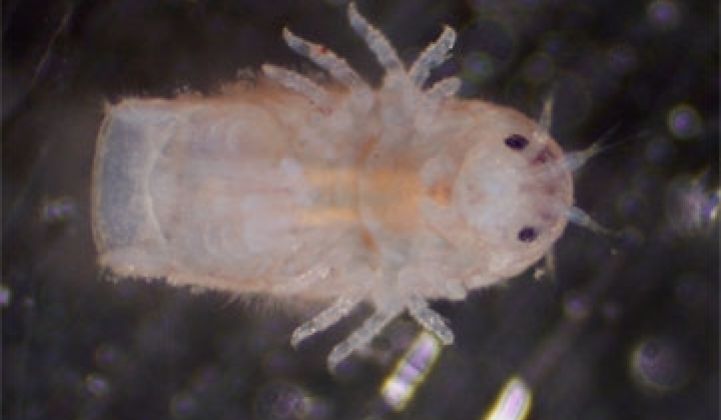
Which brings us to the announcement by the University of York and University of Portsmouth in the United Kingdom that a crustacean called the "Gribble worm" is an idiot savant when it comes to transforming wood into sugars.

The Gribble worm is more known as a pest that eats the hulls of ships.  It turns out the bacteria in its stomach produces the requisite enzymes that can break cellulose into simple sugars. 

While the discovery of this worm is novel, the idea of using an organism to produce enzymes that breakdown C5 and C6 sugars is not.

Advanced pioneers like Mascoma, Amyris, LS9, and Qteros (see A Closer Look at the Q Microbe) are pursuing microbes that enable saccharification and fermentation to occur simultaneously.

Whether the Gribble worm's process is scalable is another issue, but such minor details do not seem to make it into the hyperbolic press releases announcing these 'discoveries.'



5 Comments

  • Maike Rentel 03/11/10 2:56 PM

    “The Gribble worm is more known as a pest that eats the hulls of ships.  It turns out the bacteria in its stomach produces the requisite enzymes that can break cellulose into simple sugars.”
    This is not quite right - the Gribble produces the necessary enzymes to break down cellulose and lignin themselves. No bacterial partners involved, it’s all encoded in the animal’s genome. Pretty sweet (including literally). But what does it mean for scalability?

    Reply
  • John F. 03/11/10 3:19 PM

    Does the Gribble worm rely on intestinal bacteria to produce the cellulase, as this article states, or does it create the enzyme itself.  Other sources I could find either say the latter, or “probably” the latter.

    Reply
  • Mark Radosevich 03/11/10 3:35 PM

    Most biomass contains complex carbohydrates called polysaccharides and lignin.  When producing cellulosic ethanol, one first has to pre-treat the biomass to separate the lignin from the cellulose and hemi-cellulose.  Once separated, the lignin can be burned, reducing the need for external energy sources to fuel the process,,,,,

    •••••••••••••••••••••••••••••

    Joshua,

    You and many others are missing the most obvious point in producing a new, profitable biofuel which does not compete in any way with food supplies.  Simply examine what ethanol or other biofuels are made up of…  And this is carbon, hydrogen (hydrocarbon oils) and if a oxygen atom is included, then the end product is methanol, ethanol or other higher mixed alcohols such as propanol, butanol, pentanol, hexanol, heptanol, octanol, nananol and 10-carbon decanol. 

    Now how do you source-separate these basic carbon, hydrogen and oxygen building blocks from non-food feedstocks?  Should we utilize enzymes, yeasts or Gribble Worms?  Or should we maybe revert to something 24x7, continuous (not batch) and thermal like clean and super-heated steam?

    Using genetically engineered biobugs (enzymes and yeasts) is the wrong way to go about this process.  The lignin (stalky material) which you quote above needs enzymes and cooking to be separated from cellulose and hemi-cellulose in wood chips.  This same left-over lignin still contains lots of available basic carbon building blocks which could have been transformed into alternative fuels.  The Danish enzyme pre-cursors to bio-driven, slow and inefficient batch fermentation processes can’t break apart this tougher lignin material—so you suggest that it be burned to provide process heat AFTER it was inefficiently separated from other components in biomass waste streams.

    What IF the all the basic elements contained within the biomass waste material were cleanly gasified instead?  This process of gasification re-arranges ALL of the carbon atoms, hydrogen ions and oxygen atoms contained within the raw feedstock (be it wood, garbage, sewer sludge, tires, coal, pet-coke, etc.) into intermediate synthesis gas composed of CO & H2.  Then these basic building blocks can be re-arranged into fuels through a second-step of gas-to-liquids (GTL) fixed-bed catalysis and reconfigured very profitably into synthetic and biodegradable higher mixed alcohols at low cost.

    If more expensive oils are wanted—then this same CO & H2 syngas can be converted to synthetic oils in a slightly different GTL process.

    Expect some additional ‘discoveries’ to dawn upon you and other reviewers in the very near future which are totally opposite of the technologies which you have described in your article. 

    Mark Radosevich
    Standard Alcohol Company

    p.s.  You were correct in saying that there are a dearth of commercial projects out there which are not being covered (nor understood) by the media amid the hype of hyperbolic press releases.

    Reply
  • Les Blevins 03/12/10 11:19 AM

    Mr. Radosevic you are correct in determining that gasification is the way forward and not enzymes and bugs. I’m developing a gasification technology for bulky low-value biomass fuels with this pathway in mind and now my firm is looking for B2B alliances and financial backers.

    Les Blevins
    Advanced Alternative Energy Corp.

    Reply
Need an avatar? Get one here: Gravatar
.