
Plug or plant? It's the debate of the era.
Policy makers, the public, automobile manufacturers and even oil companies agree that the world's transportation infrastructure needs to be upgraded. The question is how. Is it better to build electric cars, or does it make more sense to brew new fuels? Engineering or biology? Vegetable or mineral? At times, it sounds like a religious debate.
Chances are, they will co-exist, according to Solazyme CEO Jonathan Wolfson. The ultimate affordable green car in that sense will be the German plug-in diesel running on algal fuel.
But still, which will be dominant? I change my mind about every 10 minutes, but lately rank it as: 1.) plug-ins; 2.) biofuels; and 3.) all-electrics. Here are some of the factors to consider:
1. Current Status: Batteries win here by a big margin. They exist. They cost a lot, but you can actually buy them and build a car.
Biodiesel and ethanol exist too, but I'm going to throw out the traditional soy/corn/palm varieties that grow on arable land needed for crops. Cellulosic ethanol only really exists in labs. The closest substitute on the market is probably Rebel Yell (a fine, wheated, straight bourbon whiskey that goes well with shooting road signs and handfishing).
The same goes for the promised biodiesel from marginally arable lands – jatropha, tallow, algae, gumweed. They only exist in comparatively fringe quantities. The only really large-scale alt biofuel comes from waste vegetable oil and meat scraps. But even if you scraped together every bit of fat from deep fat fryers and slaughterhouses in this great land of ours, you could probably only make two billion gallons of fuel or less. That's a drop in the 65 billion plus gallons of diesel consumed in the states a year. Unless we start eating more Hot Pockets, that figure won't change.
2. Factory Capacity: Tie. It stinks all around. The battery world actually doesn't have that much excess capacity right now. Jeff Depew, CEO of battery maker Imara, estimates that, worldwide, battery makers can currently make about 720 million cylindrical 18650 lithium-ion batteries a year and 18650s account for around 85 percent of the output. If a large car maker decided to put out 100,000 plug-in cars, that would suck up 200 to 300 million of those cells. Notebook makers probably aren't going to let that happen.
On the fuel side, there are only around 70 crushers for biofuels in the U.S., according to Draper Fisher Jurvetson's Courtney McColgan and new ones cost tens of millions. The only good news is that traditional ethanol makers are scrambling for anything they can do that's productive.
3. Raw Materials and Scalability: The big unknown. Some analysts say that lithium prices will escalate because of limited supplies of the metal, which is now often mined in unstable countries like Bolivia. Others point out that its No. 3 on the Periodic Table and not some exotic substance. Simbol Mining is also working on a way to suck it out of geothermal wells (see Green Light post). Additionally, some startups have devised zinc batteries. Zinc is everywhere – pennies consist of 97.5 percent zinc (see Electricity From Air and Zinc? A Growing Chorus Says Yes).
But either way, mining remains non-renewable. Ultimately, someone has to crawl into a hole and dig out the minerals.
Besides being renewable, farming is freer from geography. The land might actually exist. Algae advocates claim that they should be able to get 5,000 to 10,000 gallons of feedstock per acre per year. Round that to 7,000 gallons/year/acre for argument's sake. That comes to 4.48 million gallons per square mile (640 acres per square mile).
The U.S. consumes about 145 billion gallons of petroleum a year. 72 billion gallons divided by 4.48 million gallons per acre comes to 16,071 square miles. That's slightly smaller than Nye County, Nevada (18,000 square miles.). Would you miss Nye that much? I grew up in Nevada and had to drive through it several times: Some parts are nice but others might was well be declared an open-air prison. You're not missing much.
Dallas Hanks at Utah State says there are 22 million acres next to freeways and inside military bases that could be planted with drought-resistant oil plants (see At Biodiesel Show Freeway Plantations, Chinese Tallow and Algae Anger).
The picture for cellulosic ethanol is somewhat similar. Zeachem says it can get 135 gallons of fuel per ton of material and that tree farmers can get 20 tons per acre. That's 2700 gallons an acre, or 1.73 million gallons a square mile. That's 42,000 square miles for 72 billion gallons. That's half of Wyoming. A beautiful place, yes, but there's room to tuck away some farms.
Zeachem's Jim Imbler puts it another way. If you swapped out the acres dedicated to corn for poplar and used Zeachem's process, you could probably supply 15 percent of the nation's liquid fuel needs. That's without new lands.
And the added benefit: fuel farming would cause an employment boom in the often-depressed middle of the country. It will also be easier to get farmers to grow gumweed than get battery makers to put factories here.
The big question mark is water. Can these crops really get by with low levels of irrigation?
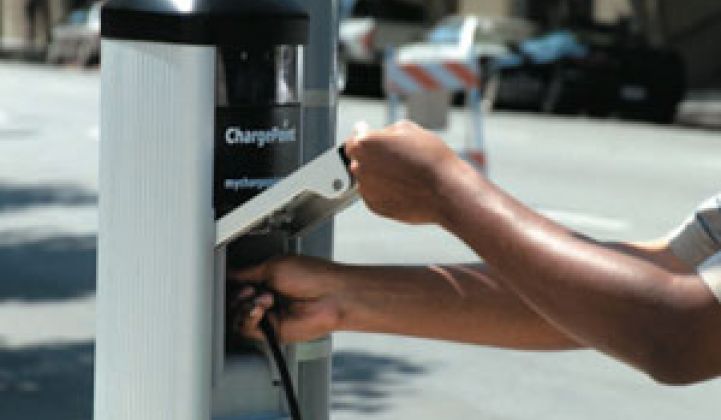
4. Consumer Infrastructure: Slight edge to batteries. Most people will be able to charge their cars at home. Home charging will likely require an upgrade to the grid, but that's already taking place to implement demand response programs.
Public charging stations also may not cost that much. Coulomb Technologies says that it can install electric charging stations for around $3,000.
An ethanol tank and pump cost $100,000 to $150,000, according to Propel Biofuels, which is building stations. Ethanol can't be shipped in regular pipelines. Biodiesel's infrastructure already exists. Electric fans will argue that there aren't many diesels in America. Thus, the diesel advantage is overstated. True, but there are even fewer electric cars.
5. Fill-Up Time: Biofuels win hands down in a big way. It will take five minutes to fill your car. Electric cars will take hours – that's a long time to spend looking at novelty bumper stickers and air fresheners – and a billing system will have to be imposed so people just don't unplug coke machines and fill up for free. High-powered charging stations that can charge cars in minutes could alleviate this, but neighbors would have to be willing to live with brown outs. The potential for injury and death would scare many consumers.
6. Driving Range and Cost: The Tesla Roadster costs $109,000 and goes 250 miles. Thus, on a family trip to Disneyland, you will need to spend a few hours in Coalinga to recharge. The Think City costs around $42,000, but it isn't freeway legal. One Think fan said the car would be cost effective for people who had to commute from San Francisco to San Jose every day, as long as they took surface streets instead. True, but the anger management bills would eliminate any benefit.
Biodiesel and ethanol are no bargain at the moment but it will come down. A gallon of algae biodiesel costs $33 to make in the lab (see Algae Biodiesel: Its $33 a Gallon). In two to three years, however, it might be down to $1.50.
7. Consumer Appeal: Has to go to electrics. Look who is buying hybrids now. It's the NPR/Obama demographic: upper middle class professionals who believe in greater equality as long as their kids don't have to attend underperforming public schools.
Alt-fuel conferences tend to have a more Lonely Planet edge to them. They aren't the people shopping at the farmer's market. They are the ones working at it. It's just less upscale.




 41
41
 15
15
 9
9