Are LED Fluorescent Tubes Ready for Prime Time?

Light emitting diode (LED) fluorescent tubes begin to catch on with consumers—but do the long-term savings outpace the upfront investment?

Are LED Fluorescent Tubes Ready for Prime Time?

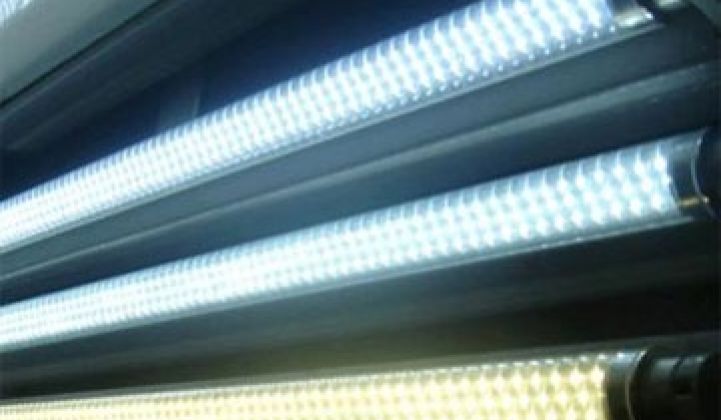
Light emitting diode (LED) fluorescent tubes are all the rage in the lighting market these days. The technology promises to be more energy efficient, less environmentally harmful and more economical than traditional fluorescent tube lighting. Still, there is a lot of debate over whether they are ready for widespread commercial use.

We recently came across an instance in which this very debate was being discussed in a LinkedIn electrical construction group. It was a heated thread with two electrical contractors hashing out the pros and cons of using LED fluorescent tubes. To continue our series of articles on “green” construction, we thought we’d tackle the issue ourselves. So here we present our findings on LED fluorescent tubes.

What is a LED Fluorescent Tube? Actually, “LED fluorescent tube” is a misnomer. LED lights and fluorescent lights are completely different technologies. LEDs are very small bulbs illuminated by movement of electrons in a diode. Fluorescent bulbs use electrodes and a gas combination of argon and mercury to produce light. As such, the name “LED fluorescent tube” really refers to an LED tube that reminds us of traditional fluorescent tubes (such as the one that is likely overhead as you read this).

LED lights should also not be confused with compact fluorescent light (CFL) bulbs. CFLs use the same technology as fluorescent tubes to produce light, but on a smaller scale. They are a replacement for the incandescent bulbs commonly found in most home light fixtures. CFLs have garnered a lot of press because of their energy efficiency and environmental benefits (i.e., they are considered to be greener than traditional lights because they use less power).

An LED tube is made up of hundreds of individual LEDs. They come in a variety of sizes (2, 4 or 6 feet), different temperatures (i.e., different colors of light), and varying arrays of LEDs. They can be purchased with new fixtures, or used for retrofitting existing fixtures. However, they don’t require the ballasts that traditional fluorescents need, so those will need to be removed when replacing fluorescent bulbs with LED tubes.

When comparing LEDs to fluorescent tubes, here are four key specifications that should be reviewed:

  • Lumens – This is the unit of measurement for strength of light. Look for tubes with 1500 lumens or more.
  • Watts – This is a unit of measurement for power consumption. Four-foot LED tubes typically use 15 to 25 watts, while fluorescent tubes of this size use more than 30 watts.
  • Lifespan – This is how long the bulb will last. It’s measured in hours. 50,000 hours is common for LED tubes.
  • Color temperature – The temperature of the light is the color of the light. It is measured in units of absolute temperature, or Kelvin (K). 3000K is considered warm (redder), 4100K is considered neutral, and 5800 K is cool (bluer).

Pros and Cons of LED and Fluorescent Tubes. To give recognition where it’s due, fluorescent tubes are a great invention. They have been lighting most of America ever since GE brought them to market back in 1938. They are four to six times more energy efficient than incandescent bulbs and are said to last 10 to 20 times longer. Of course, they come with their own set of disadvantages, as well.

Fluorescent tubes contain mercury and phosphor, which present a number of health and environmental risks. The lights require a ballast, which adds to the cost of the lamp and can cause a buzzing noise. Finally, they frequently flicker, and the light is often drab.

On the other hand, LED bulbs last longer than fluorescents, and they don’t contain harmful ingredients like mercury. Perhaps most signficantly, LEDs use much less power than fluorescent lamps -- and there are many other benefits, as well.

Still, LEDs aren’t perfect. The tubes are generally not as bright and can cost more up front. And unfortunately, cost will likely be the number-one driver of greater adoption. So let’s compare the costs of each type of bulb:
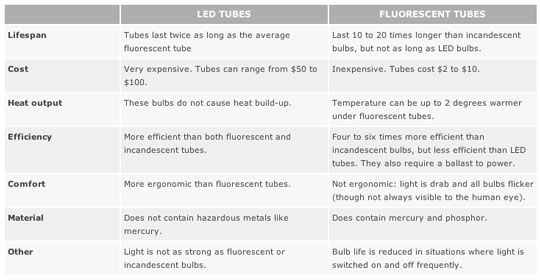
Costs of LED Tubes vs Fluorescent Tubes. The debate over LED vs fluorescent tubes always teeters when it comes to the cost argument. When comparing the upfront cost of one LED tube to one fluorescent tube, fluorescent wins, hands-down. However, when you consider volume discounts and the longer lifespan of LEDs, the scale leans the opposite direction. Let’s compare the costs of each taking these factors into consideration.

This table compares the first-year cost of a single commercial-grade (i.e., UL and CE compliant), four-foot T8 LED tube to a four-foot T8 fluorescent tube. To measure kilowatts per year, we assumed the lights would be on for 12 hours a day, 255 days a year. We used an average energy rating of 20 watts per hour for LEDs and 32 for fluorescents. To calculate energy cost, we used an average cost per kilowatt of $0.11.
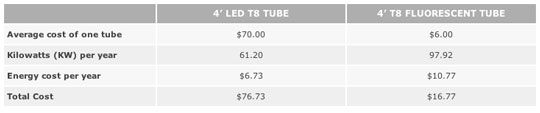
Clearly, fluorescents are less expensive in the first year. However, when you account for product longevity, LED tubes are the winner. LED tubes last an average of 50,000 hours (roughly 16 years) while fluorescent T8 tubes last an average of 25,000 (roughly 8 years). To determine this, we looked at every fluorescent T8 tube that Sylvania offers (nearly 150) and calculated average lifespan. To be precise, it was 24,787.67 hours.

In this next table, we compare the 16-year cost (the lifespan of an LED tube) of 40 LED tubes compared to 40 fluorescent tubes. In this example, the number 40 is somewhat arbitrary. We have 20 2′ x 4′ fixtures in our office, so we chose 40 bulbs as our basis of comparison. Keep in mind, fluorescent fixtures require ballasts, so we’ll need to tack on an additional $400 to fluorescent tubes (20 ballasts at $20).

Using prices from our previous table, in the first year it will cost $3,069 for the energy and initial purchase of 40 LED tubes. The fluorescent tubes would cost $1,071. Every year thereafter, the energy costs of LED tubes will be $269, and $431 for the fluorescents. In the eighth year, the fluorescent bulbs will need to be replaced at a cost of $240.

You’ll notice the numbers in our table look a little different. That’s because we’ve included an annual energy inflation rate of 5%. We also used a 2.5% inflation rate to calculate the cost of the replacement fluorescent bulbs in the eighth year. Finally, we used a 6% discount rate to determine the net present value (NPV).
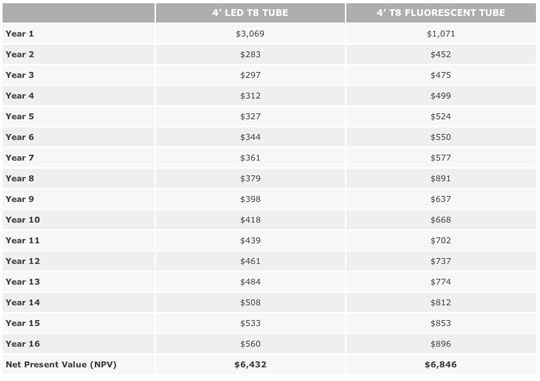
As our analysis reveals, the 16-year cost for 40 LED tubes is $6,431, while the cost for fluorescent tubes is $6,846. This is 6% in savings over the life of the tubes. Keep in mind, this is only 40 tubes. Building owners with more light fixtures will realize more savings, as the volume discount will be greater and energy costs will be lower. So, over the lifespan of the product, LED tubes are more cost effective than fluorescent tubes.

A Bright Future for LED Tubes. The cost of manufacturing LEDs is dropping. Researchers at Purdue University have developed a way to create LEDs using inexpensive, metal-coated silicon wafers instead of expensive sapphire-based bulbs. This discovery has the potential to bring the cost down to levels competitive with fluorescent tubes. You can stay up to date on news of this development over at the Eartheasy blog.

In the meantime, there’s no reason electrical contractors shouldn’t promote LED tubes. LED tubes can help building owners achieve eligibility for government and utility company incentives. They help companies capture the desirable -- and highly marketable -- green cachet. They provide greater energy cost savings than fluorescents. And finally, they are simply better for the Earth. They are the future of commercial lighting.

This article originally published on Software Advice at: Are LED Fluorescent Tubes Ready for Prime Time?
 

12 Comments

  • blueskies 05/7/10 6:07 PM

    LED tubes might make sense in new installations, but it’s hard to justify the savings in existing T5/T8 fixtures. when a ballast or lamp goes out, i can head over to a local home depot to get replacements. perhaps there are time/labor savings as fluorescent lamps go out more often, but on the other hand, LEDs still don’t offer consistent longevity or lumen depreciation. $6 for a 4’ T8 sounds on the high side as well, when buying larger quantities for an office, typically it’d end up around $3 a unit for a 30k hour bulb at 3000 lumens a piece, LEDs aren’t quite as bright. maybe LEDs consume less power but when comparing photopic and scotopic lumens/watt, tri-phosphor fluorescent lamps are very competitive with the most efficient commercially available LED tubes at a far lower price. i do think LEDs will eventually drop in price for it to be much more competitive and of course there are the environmental benefits of small packaging and no mercury content (even though it could have other toxic metals) but for now, i don’t foresee fluorescent tubes going away soon.

    Reply
  • mds 05/8/10 9:37 PM

    Nice analysis.  You forgot to add the cost of replacing flourescent lights after eight years and you forgot the cost of labor to install and replace lights.  Case for LED lights gets a little better when this is considered.
    Also, you are using an electricity cost of $0.11/kWh which must be about average for the USA.  The case would be far more compelling for a building in Hawaii or the Caribbean where electricity can be $0.20/kWh to $0.40/kWh.  Blueskies indeed.

    Reply
  • reality-check 05/9/10 2:05 PM

    I would advise everyone thinking about this application to review the DOE CALiPER Round 9 report at (http://www1.eere.energy.gov/buildings/ssl/reports.html). The DOE has conducted independent testing of manufactures claims and has found the products fail to deliver.

    The author of this article advises to look for LED T-8 replacement products that provide 1500 lumens. A favorite claim of manufactures is an output of 1500 lumens @ 15 watts. This is an efficacy of 100 lumens per watt. This claim is pure fantasy. Currently, there is not a single LED product of any type that can deliver that level of efficacy. 

    When purchasing any LED product, always request a copy of the LM-79 test performed by an independent test lab. If a supplier can not provide this document,  you should not purchase the product.  Lets stop the hype and deal in reality.

    Reply
      • tranh 05/10/10 3:40 PM

        Re. LM-79.  We do A/B comparison with a light meter.  Wouldn’t that be better to see the on-site result with your naked eyes instead of reading some esoteric report?  A light meter costs about $50.  A LM-79 report costs $1500.  It can be easily falsified.

  • Carl Hage 05/9/10 2:41 PM

    There is a big problem with the above analysis—“less energy” is touted in a “replacement” bulb, but the Lumens/Watt are not specified. It looks like in the “Other” column, it says “light is not as strong”. Please be sure to quote Lumens when comparing bulbs as “replacement” in LED bulb marketing often means fits in the same socket, not gives an equivalent amount of light. It appears that the same mistake is made above, with lower energy cost primarily due to lower light output. You can get the same savings by unscrewing a bulb.

    I looked up the Lumens for LED tubes and efficient T8 fluorescent bulbs—the LED was 15W and 1200 lumens (another is 17W/1200L), whereas the T8 tube is 32W and 2900-3050 lumens. The LEDs I found are slightly less efficient in lumens/watt than fluorescent, but really very close. (A 2’ tube was 8W/650L for LED and 8W/600L Fl—LEDs slightly ahead). The luminaire might degrade the raw L/W, but the efficiency for LED and fluorescent is comparable except for spot lighting.

    In addition to directional light applications, LEDs have a big advantage because they can be dimmed and work with motion sensors, etc. turning lights on and off many times per day. When combined with daylighting, the lamps could be auto-dimmed to provide the appropriate supplemental light. But these advantages weren’t mentioned above.

    Unless LEDs are combined with dimmers, motion sensors, or directed lighting, there is no significant advantage over fluorescent other than lifetime & install cost. But with such “smart” lighting, there could be a big advantage.

    The cost figures above are bogus because the savings in electricity are primarily due to lower light output.

    Reply
  • Ronald Perkins 05/10/10 3:45 PM

    Interesting article and comments.  I think the most important issue was left out.  Reduced air pollution, green house gases and for new projects the avoided cost of electrical distribution equipment and HVAC loads.  When the whole system is considered, I think the LED technology is clearly the winner.  So add about 20% for avoided first cost of air conditioning and about 15% for reduced HVAC electrical consumption and we will be in the ballpark.

    Reply
  • Tom Griffiths 05/10/10 4:43 PM

    It looks like Mr. Neal fell into the common trap of “not as bright, but saves energy”. Off switch does that too. It’s all about how many lumens arrive at the target with X watts input. Anything else is a non-comparison.

    Also found it to be a concern that Mr. Neal states that “An LED tube is made up of hundreds of individual LEDs.” Other than Nichia’s DL line, those little round top LEDs, commonly sized as 5mm, but they can vary, are not built for lighting class implementations, and may have brightness and color stability only over a few hundred to maybe a few thousand hours. Nichia’s “lighting capable” 5mm line, as good as they are, only reach towards that 35,000 or so lumen maintenance lifetime. Lighting class LEDs sized for the narrow space available on a tube, can easily run to several hundred lumens output each. In a 3000 lumen tube (yet to be reliably achieved) you’d have 15-30 LEDs mounted along there,’

    One word on CALiPER data. It’s good, but always dated since it is conducted in “a round” and there can easily be a 9-month gap between the date a unit is purchased, and when the report comes out (so if it is other than “just out”, you can be looking at data that is several generations back… so how’s that Pentium II stack up in the report you’re using to select your next computer?). CALiPER is industry benchmarking to check the progress, at intervals, on specific solutions that were recently available. It’s a trend guide, and one should be careful not to assume it represents state of the art in an industry that moves this fast.

    Fundamentally, except for special high-maintenance implementations where overall light output is less critical, tubes are facing strong incumbents that work really, really well. 2012 is where this technology should be positioned. Before that, replace the whole troffer, which when purpose built, will be shipping 100+ lumens/watt from a number of qualty providers this year.

    Reply
  • Eric Fisher 05/10/10 5:03 PM

    When you use a Led out doors in the cold there is no comparason.  The Led comes on instantly no worm up.  Most fluorescen lights are vey dim in cold weather.  There is also a big inconvenience in not having to change a bulb when it goes out and the cost in labor to replace bulbs can be very high.

    Reply
  • MIke Wapner 05/10/10 5:31 PM

    Great comments, so far, on what is at best the article’s incomplete analysis.  Reference to the CALiPER testing is important.  Excerpted from the CALiPER Round 7 report(January 2009):
    “Current 4-ft LED linear replacement lamps produce significantly fewer lumens than typical 4-ft T12 and T8 fluorescent lamps, with lower lamp efficacy.  …  Troffers fitted with the LED replacement products also exhibited narrower light distribution, which could compromise illumination uniformity in existing installations.  …  Several other characteristics could potentially hamper LED linear replacement lamps in retrofit applications.  Of the four LED products tested, three required bypassing the existing fluorescent ballast to connect directly to a line voltage circuit, which would require additional labor (and expense) when retrofitting fixtures.”

    And here’s one of my favorite quotes, applying to the broader category of LED lighting products, from the Round 9 (October 2009) report:
    “Overall, about one-third of the products tested actually have accurate manufacturer ratings or specifications. About one-third of the products have manufacturer claims which only overstate the performance by about 10-20%. The remaining products either do not provide any manufacturer-published performance information or provide values which are vastly overstated by as much as 100%.”

    Another good program people should become familiar with is the Lighting Facts Label.  http://www.lightingfacts.com/  Products must meet some minimum criteria to be able to use the label, including testing according to accepted standards.  The web site has a list of 565 products that qualify for the label (as of 5/10/10).  I did a quick scan of the list and couldn’t find one tube-type product.  (It’s possible that one of the “Replacement lamps” is a tube, but from the product name nomenclature and lumen output, none appeared to be.)

    A general observation has been made that LED products designed to retrofit into an existing luminaire will often be forced into design compromises that negate a good deal of the potential benefits the technology can bring.  That said, there has been some success with PAR and downlight LED products, though efficacy in lumens per watt may always trail a design started from a blank slate.

    I’m not going to go as far as saying that tube-type LED products will never be good enough to use, but it’s going to be at least a few years until they have a chance at competing with the low cost and known performance of T-8 and T-5 fluorescent tubes in a retrofit situation.

    For new construction, newly designed 2’x2’ or 2’x4’ LED troffers can be expected to provide at least as good lumens/watt and much better overall lighting performance than LED retrofit tubes.  There are already some decent products in this category, and these should be considered the eventual competition for fluorescent tubes in an office or retail environment.

    Reply
  • richardop3 05/12/10 2:01 PM

    If you are looking to cut down your energy consumption, I would suggest you get T5 fluorescent bulbs instead of LEDs. You will save a good amount of energy with them compared to your T8 bulbs and T5 bulbs are much brighter than LEDs. LEDs do consume less watts but they are not nearly as bright plus they are very expensive to buy and maintain. You have to be careful if you want to get T5 bulbs though since they are a little shorter than T8 bulbs and do not naturally fit into their fixtures. Luckily, there are companies that make retrofit kits that come with the bulbs and everything you need to convert the fixtures. Also, right now there are a lot of incentives and rebates that you can get from the government and utility companies to help cover the cost and lower your payback period. You should check out this great research article that talks about the differences between LED and fluorescent bulbs if you are interested: http://www.lumiversal.com/upload/T5 v. LED.pdf

    Reply
  • Lindsay Lovelight 05/13/10 4:30 PM

    Aloha from the land of Hawaii where they pay big for electricity created from coal or oil shipped in. I have been involved in the renewable energy sector (Biodiesel, solar) for the last 8 years and one I heard about LED lighting from Green Ray technology out of Santa Rosa, CA I was intrigued.
    Yes there is much tadoo about upfront costs for LED, but when comparing LED to flourescent I am glad someone mentioned HVAC savings as well as no maintenance costs but I’d like to offer one very large cost and that is the poisoning of Chinese workers in the flourescent factories who handle this mercury.
    I am grateful for the efficiency that Flourescents have provided the world, but at what human cost?
    TO read more about “GREEN LIGHTBULB POISON WORKERS go to
    http://www.timesonline.co.uk/tol/news/world/asia/article6211261.ece

    With Green Ray LED I am seeing wonderful light at 4100K at 15w lasting 50K hours. We did a side by side comparison and the light was amazing.
    There needs to be a discussion about lamp economy which is the cost of the lamp, the cost of running the lamp and savings for HVAC, maintenance, carbon savings, mercury savings, overall healthy light for humans. Here in Hawaii where they are paying the highest cost in the nation, savings from lighting retrofits mean putting money back into the economy rather than sucking it away through their lighting costs.
    The real deal is this, we humans struggle with change. We are also always at the mercy of companies who make precious profits off of mercury lighting. 
    This is Lindsay Lovelight in Maui, HI where the beaches are beautiful, the waves surfable and electricity the most expensive in the US.

    Reply
Need an avatar? Get one here: Gravatar