
The sun emits heat and light, but most solar power companies only exploit one or the other.
Some people want to reverse that.
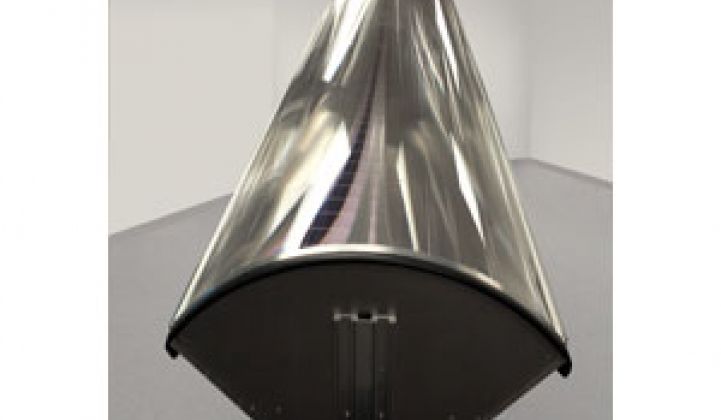
Ewing, N.J.-based Entech Solar – the product of a merger between struggling solar installer WorldWater and Solar Technologies and Entech – has devised a solar unit that contains silicon photovoltaic cells, which can convert sunlight into electricity, as well as a fluid-filled pipe that collects heat from the sun. The collected heat is then used to warm water and displace the need to run a natural gas-burning water heater.
The devices will be set up in arrays ranging from 100 kilowatts to 5 to 10 megawatts in size and sold largely to industrial customers and corporate campuses. The units, which measure which measure three feet wide, 12 feet long and two feet deep, can also be made fairly inexpensively.
"There are a lot of interesting applications for combined heat and power: meat processing plants, hospitals, hotels and resorts," said David Anthony, the principal investor at 21Ventures, which invested in Entech along with the Quercus Trust (see The Quercus Trust Continues to Grow – 47 Found in Portfolio). "There is a tremendous opportunity on the commercial/industrial side. This can deliver three to five times the energy that a pure PV system is doing."
Entech isn't alone. Distributed Solar Power and Millennium Electric from Israel are also tinkering with photovoltaic panels with heat collectors and a stealth startup in central California backed by some former Intel execs is looking to do the same (see Green Light post). Cool Energy in Boulder, Colo., meanwhile, has also come out with a rooftop Stirling Engine that it says can provide 95 percent of its hot water, 60 percent of its electricity (see Green Light post).
On the more science-experiment side of things, there are also companies like MTPV that have created thermophotovoltaic materials that directly convert solar heat into power. Combine those with standard PV panels and you get the same effect.
The driving force behind all of these companies is that heat is underappreciated. The heat that accumulates around photovoltaic panels is also a problem. By inserting a heat collector, the headache becomes a selling point.
The PV-hot water companies also like to point out that they aren't as constrained by geography as skeptics might guess because the thermal energy is being used to heat water. Solar thermal water, a staple in countries like Israel and Greece, also works in cold climates because the heat required is lower: Toronto has a Laundromat that partly relies on solar thermal water heaters from Mondial Energy.
The key to Entech's system is a Fresnel lens that can concentrate light onto the silicon photovoltaic cells as well as heat onto the fluid pipe, said Smith. Several companies are currently selling concentrators for photovoltaics, but many analysts say the concept could remain a niche, in part because of the additional cost of concentrators and trackers as well as the limited benefits that concentrators bring to PV modules. Entech's concentrator provides a 20X concentration of sunlight for the PV cells.
By performing two functions, concentration becomes economical, argues Smith.
"We will be able to extract 60 percent of the energy of the sun," he said.
How much does it cost? Smith says that the system will provide power at $6 to $7 a watt. That's high for a standard photovoltaic system, which can cost $4 or so a watt after installation. The total, though, includes heat for hot water. In the end, it's comparable, he argues.
But there is a likely potential to drop prices because the cost to build a factory is comparatively low. A 40-megawatt manufacturing line can be erected for $5 million, claimed Anthony. First Solar last September announced it would build a 120-megawatt plant for $150 million. Even if Entech can get close to its estimates, it would conceivably be a fairly low-cost provider.
"Our costs are more in aluminum and plastic," he said, referring to the raw materials for making the units. "We could get $250 to $500 million in sales in two to four years."
The company is finalizing its manufacturing processes right now and hopes to start sending units to beta sites next month. Testing at Underwriters Laboratory will begin in the summer.
So is Entech a startup? Well, if you don't count the decades it has been around. The company is a merger of two outfits, WorldWide Water & Solar and Entech. Founded in 1984, WorldWater began by supplying water pumps and consulting, particularly to customers in emerging markets. Then, in the mid-2000s, it began to serve as a solar installer. Although some installers such as SolarCity have been growing rapidly, the market hasn't been a party for WorldWide. In the quarter that ended last September, the company reported $6.5 million in revenue and a net loss of $7.4 million. (Correction: we initially called them WorldWide Water & Solar. Was getting confused with Worldwide Pants.)
In 2008, it bought Entech, a thirty-year old plus company with a variety of solar products: solar lighting systems, solar panels for satellites. The thermal/PV system was something the engineers had concocted, but never exploited, said Smith.



 41
41
 15
15
 9
9