
[pagebreak:Algae Biofuels Economic Viability]
The commercial viability of algae-based biofuels production is ultimately going to depend on economics. Regardless of whatever advances might come in terms of technological and biological breakthroughs, the fact remains that the commercial marketplace will not have an appetite for funding capital-intensive energy projects unless the risk-return ratio is acceptable to debt and equity financiers. A number of companies and government organizations have previously assessed different production designs and offered estimates of costs for algae systems. The most popular of designs previously analyzed include open ponds, open raceways and closed photobioreactors. Generally these assessments have taken a first-order look at capital and operations and maintenance (O&M) costs. The capital costs are usually broken down into costs associated with algal biomass growth, harvesting (removal of the biomass from the culture), dewatering (getting the algae to an acceptable concentration for further processing), and algal oil extraction systems. In addition, there are more traditional project costs such as engineering, permitting, infrastructure preparation, balance of plant, installation and integration and contractor fees. O&M costs generally include expenses for nutrients (generally N-P-K), CO2 distribution, water replenishment due to evaporative losses, utilities, components replacement and labor costs. In addition to capital and O&M costs, the costs of the land (or leasing) must also be taken into account as this can be a significant expense.
The data that has been publicly released shows major variations in capital and O&M costs. Some entities have reported capital costs as low as $10k/acre, while others have shown costs approaching $300k/acre. These wide variations in costs are also seen in O&M projections. For example, Sandia National Laboratories and National Renewable Energy Laboratory recently conducted an assessment of previously reported, open literature and concluded that average capital costs were roughly $57k/acre (with a 1-sigma standard deviation of a whopping $72k/acre) of utilized surface area and corresponding annual O&M costs were $27k/acre (standard deviation of $25k/acre)1. This data represents over a dozen different types of open and closed architectures, albeit some of the data is older and obviously doesn't reflect the newest results being achieved today. It is therefore challenging to estimate the costs of such systems with even a modest degree of confidence. This uncertainty has been driven by three fundamental reasons: (1) there are no large-scale commercial algae biofuels production systems with which to develop and substantiate the data, (2) those companies developing new technologies and architectures are very protective of their detailed financial data, and (3) because of the immaturity of the market, there are many unknowns coupled with a number of companies making aggressive (and likely overly optimistic) claims.
The approach taken here is to address algae economics from a different perspective than has been the norm. Instead of forecasting the likely costs for capital and O&M for a given architecture and its reported yield, let's assess what a project would require in order to make it commercially viable. That is, using traditional discounted cash flow analyses, along with justifiable assumptions on yields and revenues from algal biomass, what would the capital and O&M costs have to be to satisfy the demands of those financing an algae biofuels project? The figure below is the result of such analysis. The vertical axis represents the "total installed costs" of a project – made up of the cost of the land, capital equipment, installation and other traditional project costs as described earlier. The land accounted for here represents the utilized surface footprint of algal biomass growth systems undergoing photosynthesis, not the gross land area. Therefore this likely underestimates the true land costs as there will be large tracts of acreage (sometimes as much as 2X) not directly contributing to photosynthesis, but instead providing for access ways, harvesting, dewatering, oil extraction, pipes and plumbing, storage, laboratory space, among other functions. The horizontal axis represents O&M costs as discussed earlier.
[pagebreak:Algae Biofuels Economic Viability]
The lines on the graph depict what are called "zero net present value (NPV)" curves. These lines represent what a project would need to achieve in total installed and O&M costs to be economically viable from a commercial market perspective. Based on the economic assumptions shown in the lower right box, projects that can achieve costs on or below these NPV lines will be capable of providing the required returns to the equity and debt providers – which will ultimately be the financing mechanism for funding such projects. If your project falls on the line, you will be able to return 30 percent (average) per annum to equity providers and 12 percent (average) per annum to debt providers over the 20-year project life. If you are above the line, the project will fail to meet these required returns, while if you are below the line there will be excess profit for the owners of the project. For example, the bottom line (in orange) shows that if your total installed costs are $20k/acre, then your annual O&M costs must be roughly $4k/acre or lower. On the other hand, if your total installed costs drop to $10k/acre, your annual O&M costs can now be as high as $6k/acre and still be economically viable.
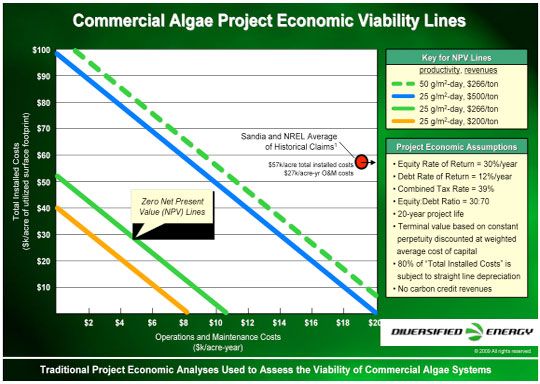
The figure provides for a very powerful and intuitive tool to understand the economic challenges facing the algae biofuels market. The orange line represents a yield of 25 grams/m2-day and a sales price (out of the algae facility) of $200 per dry ton of biomass produced. While yield projections are a subject of major debate and speculation, this productivity level represents what most experts would consider as a reasonable and substantiated expectation, one that is plausible for future large-scale algae production systems with sustained operations. Likewise, $200/ton is a metric often quoted and likely represents the low-end of revenue potential by simply assuming $0.10/lb – the middle ground for estimates of algal biomass usage as a high antioxidant animal or fish feed (generally quoted as somewhere in the range of $0.07 – $0.13/lb). The solid orange line thus illustrates the magnitude of the challenge at hand. Very few organizations have discussed total installed costs of less than $40k/acre. For reference, the Sandia and NREL data point is plotted on the figure as a red circle. When O&M costs are factored into the analyses, one must now move down the orange curve to lower and lower total installed cost hurdles. For example, fertilizer such as N-P-K costs approximately $300 - $400/ton. It is reasonable to assume that an "average" algae strain will require one ton of fertilizer for every three tons of dry algal biomass produced. At a productivity of 25 grams/m2-day, annual fertilizer costs alone would easily equate to over $4k/acre. Add onto this very sizeable energy costs for pumping and flowing water, capturing and delivering CO2 and harvesting the algae and extracting the oils. Finally, labor, water make-up and hardware replacement costs are added to the expenses. It is easy to see how O&M costs alone can derail a project's viability regardless of how low (even to zero) total installed costs become, as evidenced by the Sandia/NREL O&M average being off the graph's scale at $27k/acre-year.
[pagebreak:Algae Biofuels Economic Viability]
The solid green NPV line may represent a more reasonable case for algae biomass systems focused on biofuels production. In this case it was assumed that the algae being grown contain 25 percent total lipid content, of which 80 percent is extractable and of the desired characteristics (i.e., non-polar lipids) for biofuels production. Twenty-five percent total lipid content represents a reasonable and substantiated claim for an algae strain that can be grown sustainably, at large scale, in outdoor systems. In this scenario, for every ton of algae produced 400 pounds of oils for biofuels and 1600 pounds of biomass for animal/fish feed would then be available. Assuming $2/gallon for the oils sold out of the algae project, and $0.10/lb for the remaining biomass, this equates to roughly $266/ton for the algae produced. Based on the earlier discussion of O&M costs, one can quickly see that even at $266/ton the economics appear very challenging given the state of the industry today and for the near-term future.
On the other hand, NPV lines such as the solid blue or dashed green line begin to show an entirely different and much more plausible story for the potential of algae biofuels. The blue line represents achieving almost twice the $/ton sales price of algae biomass discussed previously. How is this possible? Using the same assumptions as earlier, algal oil would have to be sold for prices in excess of $6/gallon – which could be possible should corresponding petroleum prices reach these levels. Alternatively, this could be achieved by focusing on strains and production architectures that extract other, higher-value components from the algae such as nutraceutical products. The dashed green curve represents the same assumptions as the solid green line, but in this case assumes achieving productivity numbers twice that deemed reasonable today (i.e., 50 grams/m2-day). Quite possibly the eventual answer will be a combination of greater productivities coupled with a focus on co-generation of higher value products from algae. In addition, emphasis needs to be placed on reducing O&M costs across all elements of the algae production value chain.
By assessing the viability of algae projects from a true market perspective, it is clearly apparent that total installed costs and O&M costs will be a major hurdle to future commercialization. Technologies must be developed to reduce costs and increase yields. This can be accomplished only through a focused, comprehensive and well-funded R&D program. In parallel, the industry should consider business models that not only look at the bioenergy potential of algae through the transportation fuels market, but also consider other higher-value products in order to make the economics achievable. And this is ever so important in the early phases of this promising, yet challenging industry.
1 Phillip T. Pienkos, "Historical Overview of Algal Biofuel Technoeconomic Analyses," National Algal Biofuels Technology Roadmap Workshop, December 9–10, 2008.
Jeff H. Hassannia is Vice President, Business Development, Diversified Energy Corporation.
The above opinion piece is from an independent writer and is not connected with Greentech Media News. The views expressed here are those of the author and are not endorsed by Greentech Media.




 41
41
 15
15
 9
9