
[pagebreak:AGuidetoNewNuclear]
Uranium might be radioactive and harmful to humans, but at least it's consistent.
That, ultimately, is the appeal of nuclear power. Nuclear is one of the few alternatives to fossil fuel that can provide constant baseline power at a competitive rate, say advocates. To get around the vagaries of the weather, solar panel and wind farms would require large-scale storage, which hasn't been perfected yet.
Solar thermal fields can provide consistent amounts of power that matches well with peak demand and storage technologies that have been invented. Unfortunately, solar thermal plants only work in certain locations: transmitting that power to population centers requires transmission lines and still-evolving technologies for reducing losses. Nuclear is somewhat efficient too. The 104 commercial nuclear reactors in the U.S. supply around 21 percent of the electrical power in the country.
But don't overlook the problems – huge cost overruns, delays, land use conflicts, administrative inertia, financing, loan guarantees, waste disposal, proliferation, safety concerns.
To ameliorate some of these, a growing number of companies, national labs and investors are devising new types of reactors. While most remain in the experimental phase, the push toward commercialization has already begun. Between 2013 and 2020, some of the first new reactors might be operational.
Here's our guide to some of the more intriguing ideas.
Small Fission Reactors
Instead of building reactors capable of producing over 1 gigawatt of electric power (or more with thermal power), these reactors individually can generate 25 to 300 megawatts of heat and/or electricity. They work in the same manner as conventional reactors and coal plants: Nuclear fuel creates steam, which turns a turbine.
The individual reactors can be deployed to provide power to isolated communities or off-grid industrial sites like mines that are currently served by diesel generators. Alternatively, they can be chain-ganged together to provide the close to the same amount of power of a large facility.
The electricity from these small plants will cost about 6 to 9 cents a kilowatt hour over a lifetime to generate, or about the same as a conventional plant. (Nuclear plants in the U.S. can provide power for 7 to 8 cents a kilowatt hour; the price in the U.S. is around 6 to 8 cents with loan guarantees and 8 to 10 cents a kilowatt hour without.) The advantage comes in safety and more rapid construction.
"The financial sector is very skittish because of the delays associated with nuclear," said Burton Richter, the Paul Pigott professor of the physical sciences and a Nobel Laureate.
So far, small fission has drawn the most interest. The main players are:
• Sandia National Labs. Although it has only completed about 85 percent of the design of its reactor, Sandia has to be considered a leader because of its scientific heft, its willingness to license its technology to qualified partners, and the technological features it plans to incorporate into its reactor. It has most of the key features all rolled into one.
The Sandia reactor will be capable of putting out 100 to 300 megawatts of thermal power (large for mini-nukes) and can be sealed for several decades without refueling (curbing nuclear waste and proliferation.) The reactor core itself will sit inside an envelope of liquid sodium to cool it, which eliminates the need for pumps, pipes and other equipment that can fail. Exporting it to emerging nations is one of the goals.
Ideally, a manufacturer could make 50 of them a year at $250 million each, which translates to electricity at 5 cents a kilowatt hour. Each individual reactor might take two years to build.
• NuScale Power. Funded by venture firm CMEA, NuScale essentially is developing a smaller, similar reactor: It will generate 45 megawatts of electricity and feature a passive cooling system that relies on water. By connecting 12 or 24 into an array, NuScale hopes to build power plants that will produce power for 6 to 9 cents a kilowatt hour. Although that's roughly the same price as regular nuclear plants, NuScale's advantage is that construction time could be considerably less. That ominous, complex cement dome won't be required.
Unlike Sandia's reactor, NuScale's needs to be refueled every few years.
"Our principal market is the conventional market for providing power to the grid," said Bruce Landrey, who runs marketing. "We anticipate that the costs will be competitive, perhaps slightly less than the larger [nuclear] plants."
One advantage it has over Sandia's reactor is time. The reactor grew out of research that began around a decade ago at the Department of Energy and Oregon State University. It has built a prototype that heats water through conventional electricity. Experts who've examined the prototype and NuScale's documentation assert that it is safer than regular reactors, according to Landrey.
The company has presented the concept to utilities in the Seattle area. NuScale currently is preparing its application for design certification. It won't likely submit it to the U.S. Nuclear Regulatory Commission (NRC) until mid-2011 and it will take about three years for the agency to review it. (There are 104 commercial nuclear reactors that exist in the U.S.)
• Babcock & Wilcox. Like Sandia, Babcock & Wilcox can be considered one of the incumbents in a market that doesn't exist yet. A division of McDermott International, Babcock has designed and built nuclear reactors for 50 years. (It also makes equipment for eSolar.)
The company's mPower light water reactor will generate 125 megawatts of power. The underground reactor would be refueled every five years and last 60 years. The company will likely submit its designs to the NRC in 2011 or 2012, putting the expected date for an operation plant toward 2020. The Tennessee Valley Authority has already begun the long evaluation process.
• TerraPower. Disposal and power all in one. TerraPower wants to create reactors that will run on depleted uranium from nuclear waste sites or, possibly, thorium. Besides reducing nuclear waste stockpiles, depleted uranium reactors could conceivably extend uranium supplies for hundreds of years.
The company was incubated at Intellectual Ventures, a think tank/intellectual property firm created by former Microsoft chief scientist Nathan Myhrvold. CEO John Gilleland previously headed up Archimedes Technology Group, where he focused on the development of new technologies for mitigating waste from nuclear weapons, and served at Bechtel and the International Thermonuclear Experimental Reactor program.
• Hyperion Power Generation. The mini-mini. Hyperion's reactor, measuring 1.5 meters in diameter and about the size of a hot tub, will generate 70 megawatts of heat or 25 megawatts of energy. Hyperion buries the reactor in a cement chamber, where it only needs to be refueled every five years. The company, which came out of Los Alamos National Lab, hopes to start delivering reactors in 2013 for a price of $25 million to $30 million. Altira Group is the main investor and more funds are being sought.
Hyperion's initial target will be military bases, tar-sands mines (where it could be used to clean gummy oils) and other isolated, off-grid communities with large power needs. CEO John Deal is one of the more visible executives in this market.
[pagebreak:A Guide to New Nuclear]
Thorium Reactors
Far more common than uranium, thorium can be mixed with a small amount of uranium, bombarded with neutrons and turned into a U-233 to produce the necessary heat. Thorium reactors do not produce weapons-grade plutonium either. While some early reactors employed thorium, though, uranium swept the industry because the reaction generates more energy. Now, it may make a comeback.
China, the Middle East and India are all looking into thorium research and/or reactors. India is particularly interested, according to Richter and others, because it has a lot of thorium and extensive research into fast breeder reactors. Coastal thorium reactors additionally could be exploited to power desalination plants. Senators Orrin Hatch and Harry Reid have promoted thorium in the U.S.
• Thorium Power. D.C.-based Thorium Power was founded in 1992 to capitalize on the research of Alvin Radkowsky, who worked with Edward Teller and Hyman Rickover. The company began to collaborate with Russia's Kurchatov Institute two years later. In 2007, it inked an alliance with Red Star, a government owned nuclear plant designer.
Still, it has not taken off and most of the research has remained in Russia. Publicly traded, Thorium reported revenue of $3.4 million in the second quarter and a $1.3 million net loss.
Fusion
The ultimate energy source – carbon free, virtually limitless, and no nuclear waste.
Too bad it doesn't exist yet. In fusion, isotopes of hydrogen (and/or other elements) are combined at high temperatures (150 million degrees Celsius or so) to produce helium. Enormous amounts of energy are released.
• Lawrence Livermore National Labs. The National Ignition Facility (NIF) at the lab has devised a stadium-sized laser with 192 extremely-high powered beams. The beams can be focused onto a spot about a half a millimeter in diameter in a target chamber. If the energy can be delivered onto a fuel pellet made up hydrogen isotopes, it can conceivably cause the atoms to fuse into a form of helium, and thereby deliver more power than the lasers consume. The goal is to demo the laser in 2010 or 2011.
A Laser Inertial Fusion Energy (LIFE) reactor could generate 1 to 2.5 gigawatts of thermal power with its 10 to 20 megawatt laser system.
• MIT. Among other nuclear projects, MIT last year showed how it can exploit radio waves to propel the hot hydrogen plasma (a precursor to fusion) inside a reactor without hitting the walls or causing turbulence, which can interfere with fusion reactions.
• Tri-Alpha Energy. Founded in 1998 from research conducted at UC Irvine, Tri-Alpha creates a fusion reaction with hydrogen and boron. It raised $40 million in 2007 from, among others, Venrock.
• General Fusion. Canada's General Fusion uses a technique called Magnetized Target Fusion (MTF) model. In this scenario, an electric current is generated in a conductive cavity containing lithium and a plasma. The electric current produces a magnetic field and the cavity is collapsed, which results in a massive temperature spike.
The lithium breaks down into helium and tritium. Tritium, an unstable form of hydrogen, is separated and then mixed with deuterium, another form of hydrogen. The two fuse and make helium, a reaction that releases energy that can be harvested. (They also have a picture of a cool dinosaur on their website.)
The company raised $22 million recently. However, it has also pushed deadlines. In 2008, investors said the company might be able to show that its fusion technique is feasible in three to five years. Over a year later, it said it might be possible in five years.
Fission Fusion Hybrid
A supplemental form of power with Lawrence Livermore's LIFE reactor. In this scenario, the fusion core is wrapped in blankets consisting of uranium, depleted uranium, thorium, plutonium or other nuclear material. Neutrons released during the fusion process would pass through a series of plates to a layer of metallic pebbles, releasing more neutrons which turn would hit the f blanket, causing fission reactions. Ideally, the system would consume nuclear waste and generate fission power without generating chain reactions. (More on this in a subsequent article.)
Molecular Manipulation
Technically, not fission or fusion at all, but a form of exploiting the properties of various materials to release energy.
The CEA, France's Nuclear Commission, has an ambient thermoelectric generator that can release 4 milliwatts per square centimeter for every (Celsius) degree difference via the Seebeck Effect (coined by Estonian physicist Thomas Seebeck). In the Seebeck Effect, electric current can be generated by the energy differences between two materials in close proximity. The Seebeck Effect typically works because of extreme temperature variations – i.e., a hot pipe in a cold room. Potentially, new materials could create Seebeck power at normal temperatures.
In the same vein, deep-space spacecraft now employ nuclear batteries. In these, plutonium is wrapped in a thermoelectric material (like bismuth telluride) that converts heat into electricity. Nuclear batteries are far more efficient than lithium-ion batteries but are probably impractical for widespread commercial use, according to IBM's Winfried Wilcke.
Controversial, but well-funded, Blacklight Power says it has discovered a new form of hydrogen called a Hydrino. When ordinary hydrogen is mixed with a chemical catalyst at a relatively cool 50 degrees Celsius, hydrogen molecules turn into hydrinos, according to Blacklight. The hydrogen-to-hydrino reaction releases 200 times more energy than the amount of energy that gets released when hydrogen is burned.
"The hydrogen releases an extremely large amount of energy. There is unequivocally energy being produced," said CEO Randell Mills.
Skeptics abound and claim that it violates quantum mechanics. So far, only scientists at Rowan University, which have worked with Mills in the past, have conducted research that supports Blacklight's thesis. More tests will come. If they are right, Blacklight might be famous for a millennium. If not, get out the Bigfoot video.
Cold Fusion
Michael McKubre from SRI International continues to determine whether one could dunk palladium into water infused with the hydrogen isotope deuterium and apply an electric current. Voilà, you'd have an electric battery. The cold fusion concept has been heaped with scorn since 1989 when two University of Utah professors published papers on it. Critics noted that other institutions weren't finding the same results.
While fusion seems unlikely, the benefits if realized would be tremendous. Besides, it beats dedicating research dollars to making the iPod smaller.
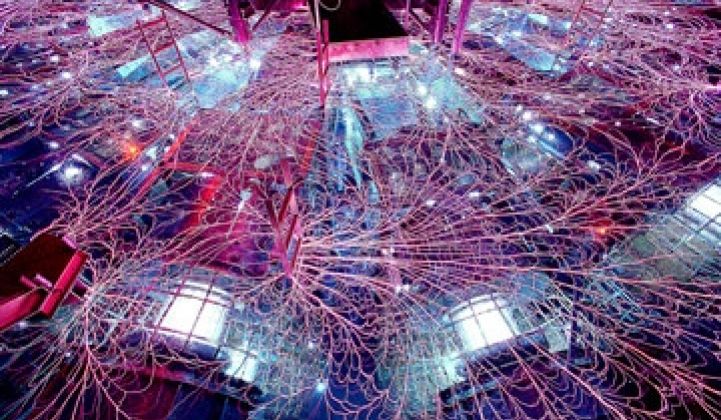
Image of the z-Accelerator via Sandia National Labs.



 41
41
 15
15
 9
9