Improved Internal Combustion Engines: Zajac Motors

Teaching the old diesel engine new tricks

Improved Internal Combustion Engines: Zajac Motors

Meetings with greentech start-ups are usually cordial affairs.  

Unlike my meeting with Zajac Motors, in which the management team alternately tried to burn and asphyxiate me. 

Zajac Motors had a point to prove.  The firm is developing a wildly efficient and innovative twist on the diesel engine and is using a new insulating material as part of the design.  Mr. John Zajac, founder and CTO of the company, placed a small square of this ceramic material on my palm and proceeded to direct the flame of a 2,000-degrees-Celsius blow torch on the material.  I suffered mild anxiety but no immolation.  It's this material that allows the company's engine to be a "hot wall reactor with ten times the duration for a complete and clean combustion," according to Zajac.

Later on, during a tour of the plant, Zajac's management team locked me in a small room while their modified internal combustion engine (ICE) ran at full speed.  The engine is so efficient at burning fuel that its emissions are minimal and one can't even detect the odor of exhaust.  Luckily, I survived another segment of the interview. 

Here's what I learned from my near-death experience:

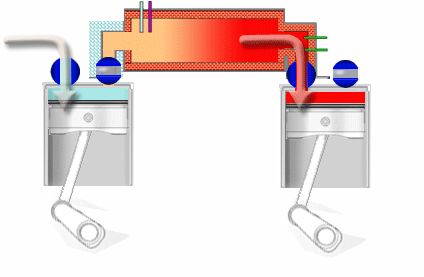
With a longer "residence time" and a constant temperature of 1425 degrees C, their split-cycle engine can make carbon fuels "virtually clean."  The engine certainly emits CO2, although only half as much as conventional diesels.  The emissions of CO, NOx, and particulates is negligible due to the high heat in the "green combustion" chamber.

Instead of intake, combustion and exhaust taking place in one location, Zajac performs these separate functions in separate places.  The distinct combustion chamber leads to better efficiency and much better emissions performance.  The secret to making the engine work is in the design of the valves --  the patented Zajec variable timing valves require much less power to operate than conventional valves, which can use up to 10 percent of a conventional engine's horsepower.

The design of this engine allows Zajac to jettison timing chains, mufflers, plugs and catalytic converters.  The new design actually adds eight new components but removes 29 other parts.

The constant temperature of 1425 degrees C and constant pressure of 600 psi make this an engine which is "self-cleaning"  and one in which the valves "can't get dirty." 

According to the firm, the new technology also promises a dramatic increase in fuel efficiency (up to 50 percent more than conventional gas engines) and the ability to change fuels on the fly, without any alterations to the engine or its power rating.  Modifications to the engine are entirely above the cylinder head.


The U.S. diesel engine market is worth $12.7 billion, according to the Fredonia Group.  The first market target for the early stage firm is the substantial off-road engine sector -- construction, oil, mining and marine.  The firm envisions a mix of revenue from sales of valves and chambers, as well as a licensing/royalty stream.  There is the potential to move into on-road vehicles after that.  The worldwide internal combustion engine market represents a $400 billion opportunity.

The Zajac Motors team members are hands-on entrepreneurs with varied backgrounds, albeit with a mildly homicidal mien.  They've raised $3.5 million from angel investors and have a working prototype with which they are currently threatening journalists.  They are in the process of raising their next round.

The team claims that their invention can "establish U.S. leadership in clean ICE technology."  Other start-ups working on internal combustion engines are Achates Power and Transonic Combustion.   

In the words of the Zajac team, "We are not making engines, we are making them better." 
 

15 Comments

  • Shauna 02/16/10 1:45 PM

    Seems awfully similar to the Scuderi engine.  Power density and packaging must suffer from the split combustion process, too.

    Reply
      • Curt 09/12/10 3:20 PM

        The biggest difference is Zajac Motors does not make engines, we make current engines greener. Scuderi is offering a totally new engine solution which will require redesigns for many different applications. Zajac is offering to take the existing engine infrastructure and make it better by eliminating the limitations of the Otto engine design by implementing our Total Combustion (Z-TCTM) technology. The only thing the Zajac engine has in common with the Scuderi engine is that they are both split cycle engines.  The Zajac engine is not just cleaner, it is “clean”, and can burn any fuel on the fly.  Although power density with split cycle engines is lower than standard engines that should not be the point of focus.  HP/in3 is old school thinking and only matters in racing and aircraft.  What is more important today is HP/ engine package and gm of fuel/HP-hr.  The Zajac engine package is about the same size as standard engines, what is different is the up to 50% increase in fuel efficiency for gasoline engines. And if you are talking hybrids our Zajac pneumatic technology (Z-IPTM) hybrid increases the efficiency buy 150% and has twice the power density of any engine out there.

  • Andy R 02/16/10 2:15 PM

    This concept is basically a gas turbine with reciprocating compression and expansion stages instead of turbomachines. It seems likely to me that the only way to overcome the material limitations of the expansion cylinder is to downgrade the power density dramatically with respect to a conventional diesel engine. In which case it might achieve attractive efficiency in a stationary test, but if it has to haul its own weight around then the result could be different.
    What was the power density (kW/kg) of the prototype?
    PS. NOx formation does not decrease with combustion temperature, it increases.

    Reply
      • Curt 09/12/10 3:22 PM

        Your recognition of this being the same cycle as a turbine is correct. The main difference between a Zajac engine and a turbine is that the Zajac engine is a positive displacement engine, which equates into higher efficiency, a flat torque curve, and less expensive parts.  Turbines are usually not very clean because the residence time in the reactor is too short (due to high speed).  The Zajac engine is actually much lighter than a diesel albeit the power density is lower.  But look at it this way.  If someone built an engine that delivered 100 mpg but that engine was twice a long—would anyone doubt that Detroit would suddenly make cars with longer hoods?  I think the answer is clear, we all want power and fuel efficiency and carrying around and extra 75lb for a 50% increase in fuel economy would be quite desirable.
        You are also correct that NOx formation increases with temperature.  The critical temperature being 1800˚ K (1527˚ C), which is why the Zajac engine runs at the constant and computer controlled temperature below that at all speeds and loads.

  • SF 02/16/10 3:36 PM

    They never said how efficient. seems like there wouldn’t be that big of an efficiency gain in a car for the same power range.

    Reply
      • Curt 09/12/10 3:22 PM

        They never said how efficient. Seems like there wouldn’t be that big of an efficiency gain in a car for the same power range.
        Reply The efficiency increase over a gasoline engine is 50-80% depending on how one drives and the overall size of the engine (number of cylinders).  When the Zajac integrated pneumatic (Z-IPTM) hybrid technology is coupled with our Z-TCTM technology the increase can be up to 150%.  The (Z-IPTM) hybrid is also only 15% the added cost to a standalone engine, vs. the added cost and weight of an electric hybrid; of course there is never any batteries to dispose of or replace.

  • Tamza 02/16/10 6:33 PM

    It certainly is a simplified system, therefore one would expect a more reliable one? As well as easier/cheaper to maintain. However, the high temp material (the ceramic you note) complicates the marketability of the idea.

    Reply
      • Curt 09/12/10 3:23 PM

        It is indeed easier/cheaper to build and maintain.  The ceramic used will outlast the metal parts used in standard engines. As a side note, it is not an exotic high cost material.

  • Meton 03/30/10 11:26 PM

    In addition to the excellent points made by the other comments:  What about the rotary valves?  They have never achieved much market success because they have not been able to compete with poppet valves.
    I seriously doubt the assertion that poppet valve trains consume 10% of an engines output.  Maybe it is so when the engine is idling and not producing any useful work, anyway.
    One of the many advantages of poppet valves is their low power requirement which does not increase with increasing cylinder pressure, unlike rotary valves.

    Reply
      • Curt 09/12/10 3:24 PM

        It is true that rotary valves for this application will not work—that is why they were tested but are not used.  The drawing showed the simplest on/off valve possible as attention was directed to the engine cycle.  The fact that valve trains consume 10% of the engine’s HP is derived from an independent source and is an industry accepted figure for internal combustion engines.  To test this, simply take the belt off of the valve train of any engine and use a torque wrench to measure the force necessary to turn it.  Then multiply that torque by the maximum rpm of the engine and divide by the constant 5254.  You will find that if that number is not 10% of the max hp of the engine it will be fairly close.
        Fact is that the force to turn the valvetrain is constant over the rpm range but the torque output of the engine is not.  As the torque falls off at low rpm the force needed to turn the valve train is still high.  When the work to run the fan, generator, valves, etc, exceed the hp of the engine the engine stalls.
        You will be happy to find that the Zajac technology uses poppet valves, these valves are unique (Zajac patent) and require no cooling, need no lubrication and take much less force to operate as there are no springs to create friction. Another nice significant side benefit is that no oil in the valve head means that one may be able to go five times longer between oil changes

  • DaveO 06/1/10 6:52 PM

    Sorry folks, this one is just an expensive experiment.  The VC’s have invested in “people” instead of “technology” again.  They have given up the best parts of the Otto cycle, which are the near constant volume combustion and high peak cycle pressures, as mentioned above, which reduces it to a brayton cycle with pistons, which has a much lower thermodynamic efficiency.  The slight increase in combustion efficiency can’t offset that.  The lower peak pressures will only increase heat transfer losses and reduce the effective expansion ratio - especially at part-load where 99% of fuel is consumed.  Similar problem in the Scuderi design.  The Scuderi folks haven’t published efficiency numbers even though they’ve spent millions!  The disadvantage of pistons machinery is that it has higher friction and heat losses at low pressures.  Since the specific power output is dramatically reduced due to the lower fuel-air ratio, the losses due to friction and heat will increase as a percentage of energy input.  Engine out hydrocarbon emissions should decrease, but carbon emissions will increase due to lower efficiency.  There are ways to achieve large gains in IC engines, but this isn’t it.

    Reply
      • Curt 09/12/10 3:26 PM

        Sorry for the long response but David O covers many issues.
        It is true that rotary valves for this application will not work—that is why they were tested but are not used.  The drawing showed the simplest on/off valve possible as attention was directed to the engine cycle.  The fact that valve trains consume 10% of the engine’s HP is derived from an independent source and is an industry accepted figure for internal combustion engines.  To test this, simply take the belt off of the valve train of any engine and use a torque wrench to measure the force necessary to turn it.  Then multiply that torque by the maximum rpm of the engine and divide by the constant 5254.  You will find that if that number is not 10% of the max hp of the engine it will be fairly close.
        Fact is that the force to turn the valvetrain is constant over the rpm range but the torque output of the engine is not.  As the torque falls off at low rpm the force needed to turn the valve train is still high.  When the work to run the fan, generator, valves, etc, exceed the hp of the engine the engine stalls.
        You will be happy to find that the Zajac technology uses poppet valves, these valves are unique (Zajac patent) and require no cooling, need no lubrication and take much less force to operate as there are no springs to create friction. Another nice significant side benefit is that no oil in the valve head means that one may be able to go five times longer between oil changes

  • Carlos Barrera 07/29/10 8:02 PM

    Tip Info / New Technology Submission - Gearturbine - Atypical

    http://gearturbine.260mb.com

    You Tube Video; Atypical New * GEARTURBINE / Retrodynamic = DextroRPM VS LevoInFlow + Ying Yang Thrust Way Type - Non Waste Looses

    http://www.youtube.com/watch?v=0cPo9Lf44TE

    GEARTURBINE -Atypical Combustion Turbine Engine, -State of the Art, -New Thermodynamic Technology, -With Retrodynamic “Dextrogiro vs Levogiro” Effect, is when the inflow direction moves is against [VS] of the circular rotary dynamic, When the inflow have more velocity the rotor have more RPM / because push the single turbine with the planetary gear, (an a example is like to move the head to the side of the strike hit) / RPM Rotor Move VS Inflow Conduits Way /ACTION VS REACTION / Front to Front / Velocity vs Velocity, making in a simple way a very strong concept of power thrust, a unique technical quality. -Wide cylindrical shape dynamic mass (continue Inertia cinetic positive tendens motion / all the motor weight is goin with the power thrust direction), -Non Waste, parasitic losses form-function engine system for; cooling, lubrication & combustion; -Lubrication & Combustion inside a conduit radial position, out way direction, activated by centrifugal force Fueled Injected (centripetal to in) , -Cooling in & out; In by Thermomix flow & Out by air Thermo transference, activated by the dynamic rotary move, -Increase the first compression by going of reduction of one big circumference fan blades going to, -2two very long distance captive compression inflow propulsion conduits (like a digestive system) (long interaction) in perfect equilibrium well balanced start were end like a snake bite his own tale, -Inside active rotor with 4 pairs of retrodynamic turbos (complete regeneration power system), -Mechanical direct “Planetary Gear” power thrust like a Ying Yang (very strong torque) (friendly loose friction) 2two small gears in polar position inside a bigger shell gear, wide out the rotor circumference were have much more lever power thrust, lower RPM in a simple way solution for turbines, to make possible for a some new work application (land). -3 Stages of inflow turbo compression before the combustion. -3 points united of power thrust; 1- Rocket Flames, 2-Planetary Gear & 3-Exhaust Propulsion, all in one system. -2two continuous circular moving inside combustion (rocket flames) like two dragons trying to bite the tail of the opposite other. -Hybrid flow system different kind of aerolasticity thermoplastic inflow propulsion types; single, action & reaction turbines applied in one same system, -Military benefits, No blade erosion by sand & very low heat target profile. -Power thrust by barr (tube); air sea land & generation application, -A pretender of very high % porcent efficient power plant engine. -Patent; Dic 1991 IMPI Mexico #197187

    Reply
  • Walter 04/25/11 10:27 PM

    This seems to be pretty cool to me but I’m really seeing it as a jet engine with positive displacement on both sides of the combustion chamber. I’m sure it’ll be able to work but if can compete in enough areas might be the bigger issues(s) If you’re interest in knocking an engine concept, go to Lullencycle.com and then give me some feedback. The site is far from finished and surely it’s unrefined. There are no investors in the common sense of the word so therefore no losers if the concept doesn’t pan out. I am the author of the site but I’m not seeking to get involved with investors, get patents etc. As for now, It’s just free as I can make it. Walter

    Reply
  • Bob 10/23/11 12:37 AM

    Was the prototype motor you saw spinning on a dyno under any load?

    Reply
Need an avatar? Get one here: Gravatar